Showing posts with label boil 'em mash 'em stick 'em in a stew. Show all posts

Sunday, 22 February 2015

And now the saga continuums

The first sowings of the year are now in the ground.

First up is Swift potatoes, which as their name suggests are supposed to be the quickest on the market - planting mid-February is supposed to result in a mid-April harvest. I picked this variety back in November, when I still thought the challenge would be a going concern and I was going to have to feed myself until June. Thankfully that's no longer the case, but I'm intrigued by the idea of a longer potato season and I'm hoping these will work as advertised. Last year's new potatoes were ready late June, so that's the mark they have to beat to be a success.

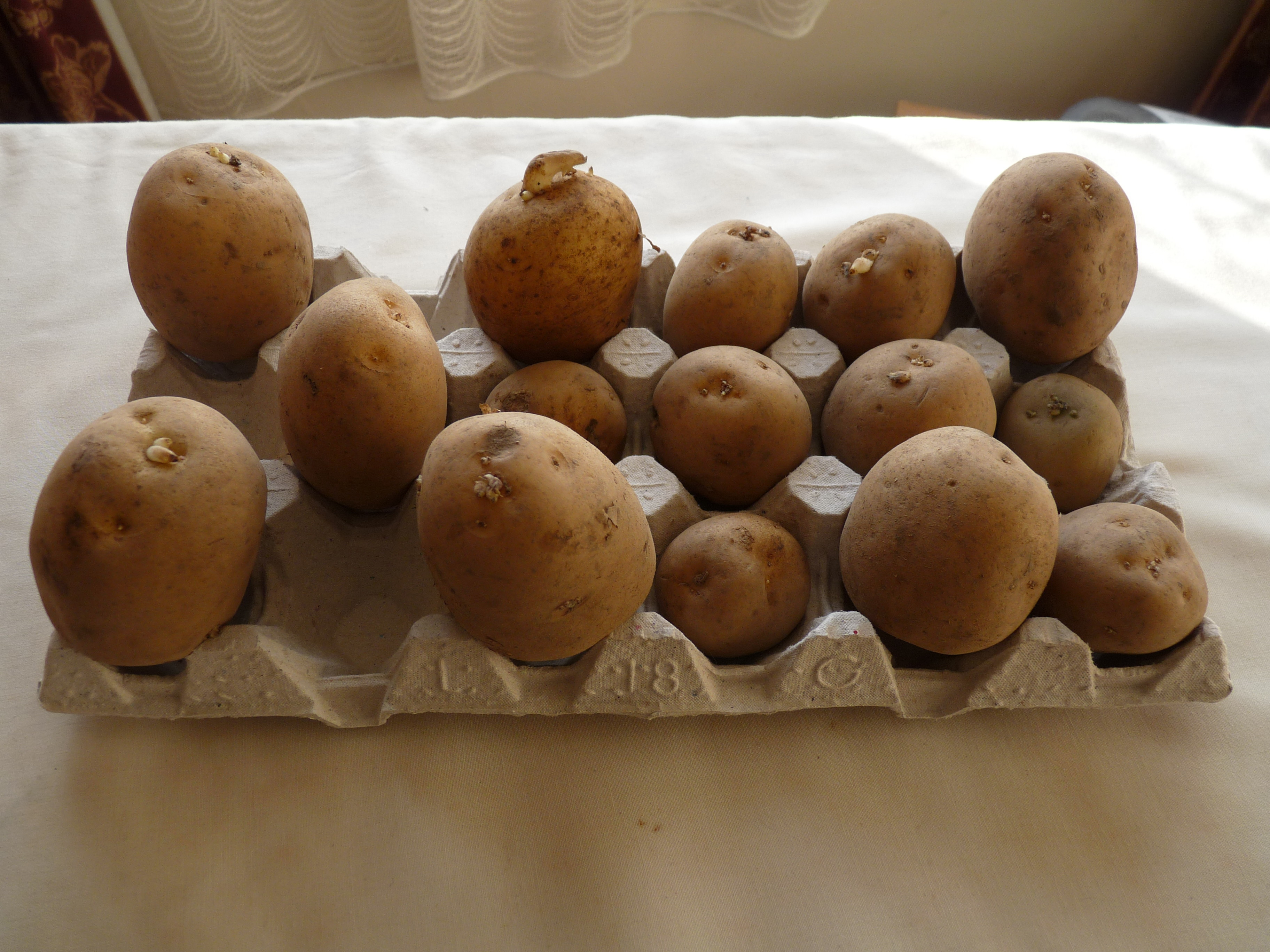
The seed potatoes have been chitting on my windowsill for the past couple of weeks, but with somewhat of a disappointing lack of results.

Underwhelming, and not promising for mid-April early potatoes.

Chitting is actually supposed to speed up potato growth, as it lets them get their first bit of growing done inside in the warmth, and I was hoping for a bit more from them. However, they're going in the potato growing bags today whether they like it or not, so hopefully they've got enough of a head start.


Due to special offers from the mail order company that I used, it was as cheap to have three packets of seed potatoes as it was to have two. Therefore I've also got Anya potatoes, a small, nobbly, tasty new potato that you may have seen in Sainsburys, and Purple Majesty, which are the logical extension of last year's Salad Blue variety. The Salad Blues were pleasingly mottled purple, but didn't taste particularly spectacular and went an unappetising grey when cooked, whereas the Purple Majesty are alleged to be purple through and through, stay purple when cooked and taste delicious. They are a vital part in my ambition of making purple soup, so hopefully they'll live up to their reputation as well.

Anyway, the downside of having three varieties of potatoes is that you cannot buy any of the interesting varieties in anything less than 1.5kg bags. I'm planting 5 sacks of the Swift and I'll still have 7-8 seed potatoes left over and I expect to have the same for the Anya as well (haven't calculated the purple ones yet).

With that in mind, is anyone in and around Bath planning on growing potatoes? If so, you are welcome to the seed potatoes free, the instructions are here from last year and I will even provide some old compost bags for you to grow them in - all you'd need to buy is about £5 worth of compost. Comment here or on Facebook please.

The same has happened with my onions - I buy them as sets (basically dried onion seedlings that you just put in the ground and they grow to full size) and you can only buy them in packets of 50. Since I'm growing both red and white onions and they have to be planted 12cm apart, that's an entire bed of 1.25mfilled with the buggers and, while I like onions, I've got more interesting things to plant as well. So if anyone wants some onion sets, they're welcome to those as well, although they'd require ground rather than pots or bags, so only good to people who have a garden.

As for other early growers, I am repeating my experiment for indoor carrots again this year, with the hope of getting better results. Not sure I fancy my chances, but never mind. I've also planted some very early broccoli seedlings, in the hope that I'll be able to spread out my broccoli harvest this year, instead of a frantic few weeks of harvesting and freezing everything. They are both currently under the artificial sun that my wife built, which is still standing because I wasn't involved in its construction.


Outside, there are some overwintering plants that I suspect will mostly come to nothing. The mild winter has meant that the cauliflower has got cocky and started producing small heads already, which will almost certainly be destroyed in the inevitable late cold snap. The carrots are, well, carrots and we know my opinions on those already. The only bright sparks are the broad beans, which are going great guns having been sown in late November. Beans of varying varieties have been the major success story of the garden, so I'm hoping these will continue the fine traditions of those that went before them.

Maybe I should just harvest it now and save myself the disappointment? 

Broad beans, momentarily released from their cat protection for the photograph. I hate next door's cats, the little shitting nightmares.

Next bit of planting won't happen for another fortnight - the weather's got to brighten up a bit first. Hopefully it won't do anything weird like March snow again.

PJW

Sunday, 31 August 2014

The purpliest potatoes and other adventures

One of the major aims of this home growing malarky is to achieve things that I couldn't get in the supermarket or grocer. And what better example is there of that than PURPLE GODDAMN POTATOES?!


It's possible that I'm more excited about this than is rational, but I think these are awesome. They're a variety called Salad Blue, which were bred in about 1900 as a Victorian novelty. Despite the name, they're not a salad potato in the slightest: they're a maincrop rather than an early, all but the smallest have to be peeled to be edible, and they fall apart if they're cubed and boiled. And they're not blue. Apart from that, great naming work Victorian gardeners!

Leaving aside the excitement of "Holy crap, purple!", the allure of purple potatoes is that they are in theory healthier. The purple colour comes from anthocyanins which research shows to have an unproven correlation with improved health and neural development (or as the Mail no doubt put it, "NEW RESEARCH SAYS POTATOES CURE CANCER"). However in terms of the taste, I wasn't blown away. They were very bland, which is weird considering you expect brighter coloured things to taste stronger.

I'm torn as to whether I'll be planting them again next year. On the one hand, purple, which is very important. They also appear to've been very prolific croppers - I've not even harvested a full potato bag yet and I've got three and a half meals out of them. And perhaps the taste issue was just this one bag and they'll improve. We'll see.


The plate of purplish chips (not as impressive once cooked. The mash that I made the next day was a bit more grey than purple too. Maybe I'll just boil them next time. Or add some food colouring) aside, there's two more interesting things about that plate. Three if you count the sous-vide perfect steaks.

The first is the end of the beans-rush. The torrent stopped as abruptly as it began; all of a sudden there were just no more beans, like someone turned off a tap. The plants are still green and still trying to grow outwards, but it looks like they're pretty much done with providing me food, bar a couple of stragglers. It's a bit of a shame actually - I spent so much effort making sure that we would eat all of the beans that I think we actually succeeded in eating all of the beans. Practically none have been frozen for the winter, so I hope we don't find a recipe that urgently requires them!

Secondly is a brand new adventure for this year's growing - corn! This came from my Three Sisters experiment, which has so far held up its end of the bargain on two out of the three vegetables. I'm not usually a lover, or even a liker, of sweetcorn, but I was told that freshly picked is a completely different flavour to canned supermarket toot and it was interesting so I thought I'd give it a go.

Corn is viable to eat when the top tassels turn a chocolate brown, but it's impossible to tell from the outside if you've got anything or not as the actual eaty bit is concealed inside the green bits. So I harvested a few likely looking husks and carried them into my wife, who was declared expert on the grounds that I didn't know what I was doing and she didn't say "Not it" quickly enough. Plus, she's admitted to liking shop-bought corn before - that's plenty expert enough for me and frankly she should know better by now.

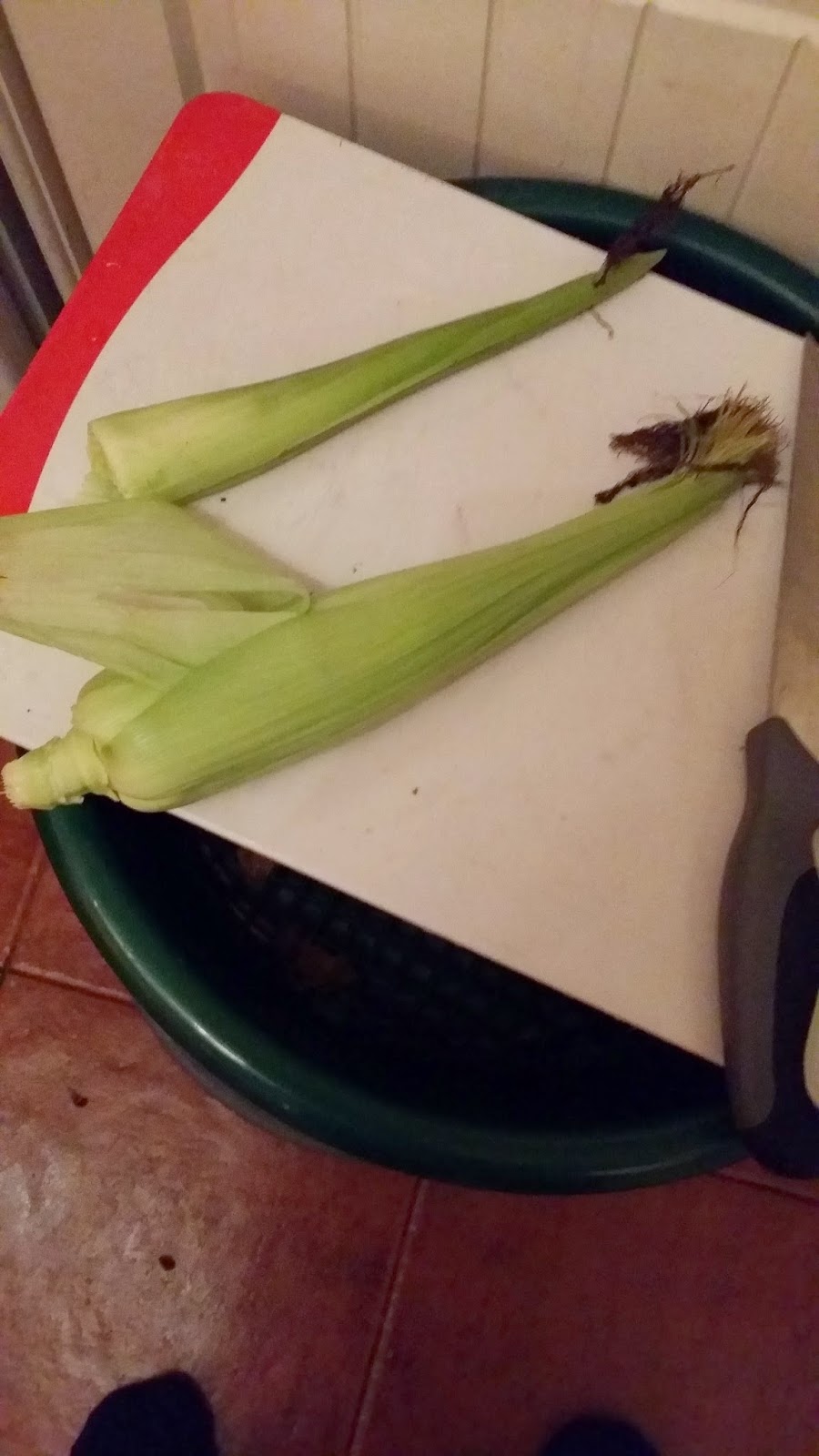
The husks felt light and I wasn't a hundred percent convinced that there was actually going to be anything inside. I thought we were going to peel away layer after layer of husk like an organic pass-the-parcel before discovering that nothing had actually grown. Imagine my surprise to find that we ended up with something that looked like you see on television!

 Before...

And after - wait, did I make that? That looks like real food! My wife used to do magic; I wouldn't put it past her capabilities to sneak in some professionally-grown corn and switch it out with some legerdemain to save my feelings. Thanks sweetie!

The corn was wrapped in aluminium foil with pepper and melted butter and oven cooked for about 10 minutes to my wife's expert instructions.


The results? Interesting more than delicious. It was very sweet and the taste was a concentration of all of those times I've eaten sweetcorn in the past and thought, "This is okay actually," without any of the bitter disappointment, aftertaste or horrible texture that ruins that thought a milisecond later. Fresh really does make a massive difference - it removes all of the nasty bits of the taste from it.

However, with all the nasty bits gone, I was left with a taste that was just okay without ever blowing my mind. It was nice enough, and I'll eat the rest of the crop this year with pleasure, but I'm not sure if I'll grow it again next year, especially given how much of a pain in the arse it was to get viable plants going without dying or being devoured. Not to mention the money I spent on constantly rebuying seedlings. Plus, since the whole point of it is that it tastes different and nice when fresh, there's very little point in trying to store it, which leave me in the situation I am now - there's two husks ready to go, but I don't fancy it right now.

It will entirely depend on if I have a spare bed in the garden once everything else is planned out, rather than being something which I will actively make space for.

PJW

Saturday, 25 January 2014

How to play along at home, part 1 - PO-TA-TOES!


The most annoying thing about a convert is the zeal with which they try and get you to join them. Try talking to anyone who's still in the honeymoon phase of going to the gym about how you're struggling with your fitness and they'll be ready, eager and keen to sign you up, full of helpful suggestions about how you could come with them, there's a class that you'd just love and you'd feel so much better! You rarely get the hardsell from a long-time gym member, but you'll always get it from the person who's been going for 3-9 months and is pleasantly surprised to find that they're enjoying themselves.

It's hard to blame them really. It's a sign they like you - they're enjoying themselves and they want to to be happy too. And it's so easy now that they're in the swing of it!

With that example in mind, forgive me.

While I appreciate that very few people have the space, time, energy or obsessive personality to build a vegetable garden quite as daunting as mine, it is very easy and very rewarding to do something small. A couple of well-placed pots or a windowsill could allow you to turn dirt into food, with very little effort or cost. Quite apart from the satisfaction of eating something you killed yourself, the vegetables you get will taste better as they've not travelled and are fresh from the ground.

So, I've decided to write up some of the easiest and tastiest vegetables that I've accomplished, at the appropriate time of the year for my loyal reader(s) to try it themselves if they so wish.

Vegetable the first - potatoes


Five reasons to grow potatoes at home:
1) They taste better than any potato you will ever get from a supermarket or farmer's market
2) Potatoes are the easiest thing in the world to grow - they don't require a bed, fiddly little seeds or any knowledge whatsoever. All you have to do is put a little potato into some dirt, water it every now and again and from it will grow a plant that makes more potatoes.
3) They don't need much space, or sunlight, or anything. More sunlight is always better, but you can grow them anywhere.
4) You get a good return for not a huge outlay. Three bags, which take up approx 3ft2 space will provide you with about 40 potatoes for an initial outlay of £20, but you can reuse the compost* and bags again next year (*compost may require a dose of inexpensive fertiliser next year). That means you'd just have to buy new seed potatoes, which would be about £2-£3 per year.
5)

Potatoes grow from other potatoes - if you've ever forgotten a bag in a kitchen cupboard and come back to spindly white tendrils, then you've accidentally a potato plant. It's best not to plant supermarket potatoes though, as they tend to be bred for eating and transport, not creating a new generation. You can get seed potatoes like these online, but you might find it cheaper (and more fun) to go down to a garden centre/Homebase and look through the varieties yourself. There are two main types: Earlies, planted from end of February and can be harvested from May onwards; and Maincrop, which are planted March and are harvested July/August onwards. Earlies are usually "new potato" types, while maincrops are bigger and more useful for chips, roasties, etc.

You often get seed potatoes delivered in January/February, as it's a good idea to chit them before you put them in the ground. Chitting just means leaving them in a cool, bright position, usually in an old egg box, so that they can get the light and start sprouting sprouts. It's not essential to do this step, but it will speed up your harvest.


People think of potatoes as being something grown in the earth and dug for, but the easiest way to grow them is in a bag on a patio or other hard surface.You can get a specially designed bag like this one for only £2.99 on Amazon, but you can also recycle an old compost bag if you have one/live anywhere near me and want to cadge one. I've got dozens going spare, so feel free. The only rules for the bag are that it has to have some holes in the bottom to drain water and that it has to be relatively opaque. Potatoes that see sunlight while they're in the ground are bad for you, so no clear tubs, bags or boxes.

All you need do is roll the edges of your bag down so that it's only about 1-2 ft high and pour in a thick layer of compost. Put in three seed potatoes on the compost, equidistant from one another and with the sprouting bits pointing up, and cover them up with another layer of compost. Water them twice a week or whenever the earth seems dry - a surprising amount of edible potato is water, so best to keep them too damp than too dry.


In time, you will end up with three bushy green plants poking up through the soil. When they are about 1.5ft high, roll up the edge of the bag so that it's now as tall/slightly taller than the plant and then pour more compost on top of the plants until all but the top few leaves are covered. Yes, this will feel like you're murdering the plant that you worked so hard to make happen. However, we're not interested in the green bit; we're interested in the potatoey-goodness of the roots and the deeper the dirt, the more room there is for spuds.

The plants will recover from the indignity of being earthed up and will valiantly create another 1.5ft of foliage again. Teach them that life is cruel, roll up the edges of the bag to make it deeper and pour more compost on, again leaving the top few leaves uncovered.

Rinse and repeat until the bag is fully unrolled and as tall as it can get and the compost is a few inches from the top. The potatoes will revel in their freedom and create a bushy top of green bits and sometimes flowers to celebrate. Ignore this; they're just showing off.

What you're waiting for is for the green bits to start dying. Yes, it's a plant that signals when it's done by going yellow and falling over - how great is that?! Once that happens, your potatoes are just about ready. You don't need to dig them up immediately - you can leave them in the bags for several months and it won't make the slightest difference to them. Some of mine last year stayed in the bags for 6 months without any effect.

All you need do is cut off and remove the dying greeny bits and dig through your compost, looking for spuds. It's quite a good idea to save the bag that the compost came in and then you can pour it back in bit by bit and remove the potatoes as you see them. As I mentioned earlier, everything can be reused next year with a little bit of extra fertiliser.

If anyone in and around Bath is interested in trying this, there is a good chance that I will have a couple of seed potatoes and some usable bags that will be open to good homes. Apply below if you want to give potatoes a try.

PJW