Showing posts with label weird coloured vegetables. Show all posts

Monday, 20 July 2015

Passed times

So, yes. A few things have happened since my last post. The most significant is the reason why there's been such a hiatus - my new daughter arrived earlier this month and preparations for her arrival took up a significant amount of my gardening time and all of my writing-about-gardening time. However, I am currently in a briefly quiet house, with two precariously sleeping daughters, and have finally had time to go through all of the photographs that I've taken of the garden things that have happened since Wednesday 10th June. It seemed like a good time for a blog.

Following on from one of the last posts, I've learned a great deal about my experimental vegetable of oca. Mostly, it's that the research I did on it which called its growth "low, bushy ground cover" have a very different interpretation of low and bushy to me. The tomato pot that I excised the oca from last month has since gone on to produce some thriving tomato plants, however, the ones where I left the oca in are struggling to keep their heads above water:

 Let's play the "Spot the Tomato Plant" game! I promise you, there are three to find in this picture. One of them might even survive!

I've tried trimming them, tying them down to reduce their height (they're supposed to collapse to the ground in autumn anyway), squashing them under the tomatoes which I've staked up to encourage them to grow above the morass. No joy - it seems they thrive on being beaten and take up waaay more space than advertised. I think if this bed is to be repeated next year (which isn't a given, considering I don't even know whether I like the taste of the damned things yet!), then it will be with one oca plant flanked by two tomatoes, rather than the current setup of two ocas and three tomatoes.

One thing which I did learn from researching whether I could prune them is that the leaves are edible and actually quite tasty. They're lemony and tart and would go very well in a salad, assuming of course, that I ever ate any. Still, a bonus for any salad eaters out there who fancy a dual use crop.

Speaking of salad-dodging, the exciting adventures in making a tower garden from coke bottles have ended in complete disaster.


It was such a good idea in theory, but the practice has been let down on two fronts. The first is that it requires constant watering - by dint of its position by the drainpipe, it is sheltered from the rain and the very small surface area at the top would minimise any weather-based watering anyway. This is exacerbated by the fact that the bottles are see-through and so the sun bakes the dirt with the greatest of ease, leaving a dessicated tower that's impossible to rehydrate. The water flows around the edge of the dirt without sinking in and trickles out of the planting holes rather than going all the way down to the ground. I just don't have the regular free-time to water this as often as it needs.

Secondly, the design of the thing means that there's very little space for roots, meaning that you're limited in what can successfully grow out of it. Lettuce works just fine, as does sage, parsley and chives. However, the things that I actually like to grow and cook with regularly - brassicae, thyme, rosemary, strawberries - have all failed miserably as they require more space than this is able to provide.

In short, its only flaws were that it doesn't suit my gardening style nor the foods that I want to grow. Aside from that, it's perfect.

In terms of other things that have happened, actual food has started appearing, including purple potatoes and purple carrots.


These are particularly pleasing to me given my failures last year. The purple carrots are these ones, planted inside back in mid-February under the artificial sun. It's taken 6 months, but they've grown to a pretty reasonable size. I think the major ingredient which I was missing last year was patience - carrots are alleged to be ready to pull within 3 months of planting, but that's certainly not my experience this year. I've got a few more tubs of them planted at 3 week intervals and the next batch are certainly not ready to be pulled just yet.

I did manage one purple carrot last year, but it was of a variety called Purple Haze, which is the most common and popular purple carrot seed available. I've got no idea why it's common or popular, as it's actually only purple on the skin outside with the inside being orange like any other. This variety is Purple Sun, which was harder to find, but much cooler for being purple all the way through.

The purple potatoes are also a significant improvement on last year, which again suffered from being purple on the outside while less purple on the inside, as well as being not particularly tasty. These ones are very good to eat and, while they do lose a bit of their colour when cooked, I'm still hopeful of getting my ambition of bright purple soup. The only ingredient that I'm now missing is a purple cauliflower. And what are the odds of something going wrong with those, huh?

The great STRAW! experiment is undetermined as to whether it's a success or not. I was led to believe that I would be finding potatoes in the midst of the straw and that's just not been the case. Mostly, I've just had to dig through a thick layer of straw that's gone ooky to get down to the dirt, which has been delightful. However, once the straw's removed, it's revealed some potatoes sitting on the surface - not quite as advertised, but better than a kick in the teeth. Hard to tell if it's reduced my harvest at all, or even been any improvement over not hilling the potatoes at all. I think we'll see how the harvest as a whole goes before rendering an opinion, but given how much of a pain in the arse the straw has been to handle, I don't think it'll be making a reappearance next year.

I've also had a courgette, cabbage and broccoli from the garden, but those are relatively regulation vegetables for me now as they're quite simple to get crops from. However, one of the new vegetables has been an unexpected and resounding success.


This is kokihi, or New Zealand spinach, which I mentioned in a previous post. It was advertised as growing like a weed and being invisible to UK-based pests. Given that three weeks before that photo, that plant looked like this:


...And that I have cut off this amount of leaves from the plant twice in those three weeks:


...I'm willing to buy the "growing like a weed" claim. A huge, huge improvement on the sorts of yields available from regular or perpetual spinach plants, which are barely worth growing at home. I've had more meals from two kokihi plants in a month and a bit than I did from four perpetual spinach plants all last year. The only restriction appears to be that it likes direct sunlight; my second kokihi plant is near a fence and is nowhere near as impressive.

Just as impressive is the quality of the leaves that I'm harvesting. There's nothing less appetising than green leafy veg that something else has had a nibble at first and no amount of pesticides, slug pellets, companion plants or prayers has seemed sufficient to keep slugs from dining on my previous attempts at spinach, chard, and kale. The kokihi hails from New Zealand and promises that nothing in the UK recognises it as food, which is backed up from the fact that not a single leaf on the plant has had even a single hole, nibble or slug trail. They're just not even remotely interested. It's wonderful.

And while pests don't recognise it as food, I certainly do. It tastes just like spinach, cooks and wilts just like spinach and can be used in all the same recipes. It's not quite as good for you in terms of vitamins and minerals as ordinary spinach, but it's a close-run thing and I'd wager when you take into account the fact that you can pick it and eat it within minutes, rather than buying it from a shop where it's probably a day or two old (not to mention pesticides), it's probably even closer.

I'm looking forward to seeing how long it produces for, and whether it can even be extended into being a vegetable that produces in winter, which would be awesome. I also want to dig it up and see how deep and widespread the roots are - if the roots are deep and narrow, then it might make a perfect ground-cover under brassicae next year (and maybe even keep slugs and snails away from the main event), whereas if they're shallow-rooted, then they'd be perfect under green beans or tomatoes.

Lastly, I've finally found a use for those surplus cauliflowers that I had to buy in bulk. I've left them in the pretty garden, in large enough pots that they'll grow plenty of leaves, but without enough space to really accomplish anything, and they are now providing excellent food and breeding space for all the butterflies brought into the garden by the buddleja. Helping butterflies + encouraging them to stay the hell away from my crops = success in my book.

PJW

Wednesday, 10 June 2015

A surfeit of cauliflowers

Speaking of not liking to throw viable plants away, my order of 21 cauliflowers seedlings was delivered today.

As I mentioned a couple of months ago, I made the decision to just buy cauliflower seedlings to avoid the debacle of last year and was kind of narked that I could only buy interesting colours in a quantity sufficient to cover 3m2 of nothing but cauliflowers. I have room for 5 cauliflowers in my vegetable plot according to my plan and I reckon I can probably squeeze in a sixth if I harvest a cabbage next week. This means that I now have I now have 12 cauliflower seedlings in various-sized pots, taking up the patio space in the pretty garden, with another 4 still in the packet because I didn't have enough spare pots of sufficient size.

I told you - strawberries were just a red herring the thin end of the wedge,

I'm telling myself that I'm keeping spares in case of the ones I planted out dying, but I can't see myself needing 15 spares, even with my cauliflower-growing skills. Don't suppose anyone wants some cauliflower seedlings? They're in funky colours? Anyone? Bueller?

Anyway, amidst all the shocking waste, those cauliflowers mean that I've just about finished planting for the year. The only things left to go are the climbing beans for the Three Sisters (atMFWTWKLitA) and the winter vegetables - kale, purple sprouting broccoli, over-winter cauliflower and perpetual spinach.

On the subject of over-winter vegetables, I've decided against planting more broad beans for next year. The ones for this year have been a phenomenal success, providing massive plants, loads of veg and doing exactly what I expected of them. The only downside is that I've realised that I don't really like broad beans. Only a minor drawback, I know, but probably enough that I won't try and grow them again next year.

Probably.

Finally, does anyone have any idea what purslane is meant to look like? It's one of my exciting new vegetables for this year and it's supposed to grow really well as ground-cover under broccoli, but I'm having a little trouble.


See the four big things in the corners? Those are definitely broccoli - I know this because I planted the seeds in deliberate locations and marked where I planted them. See the green bits in the middle? Yeah, they could be anything.

I may have improved a lot from my days of categorising every plant as "probably a nettle", because it stood as good a chance of being right as any other guess I made, but I apparently still can't tell the difference between a weed and something I want to grow. Usually, I rely on just murdering with a hoe everything that's not in the precise location where I know I planted something, but that doesn't really work when the sowing instructions for a vegetable are "chuck on ground and eat whatever comes up."

Hopefully none of the weeds in my garden are nightshade.

I think I might just plant some more broad beans.

PJW

Tuesday, 12 May 2015

Sweetcorn racing

One fact which I was interested to learn recently was that modern sweetcorn is entirely impractical and mostly nuclear in origin. Wacky American scientists in the 1940s put lots of different seeds and plants in the path of atomic radiation, as they believed that nuclear war was inevitable and the best thing to do was research which foods would survive the radioactive fallout and be available to the post-apocalyptic survivors. Most plants, unsurprisingly, didn't take very well to irradiation, but a random mutation in corn resulted in a multitude of new varieties that decupled the amount of sugar of ordinary corn.

Since this discovery, people have been breeding these new varieties to try and get sweeter and sweeter corns. Nowadays, you'll struggle to find a variety of sweetcorn that isn't "super-sweet" (and, incidentally, less nutritious), signifying its nuclear origins. However, like the bulldog, cross-breeding in search of a few characteristics has left us with a poor fragile cripple that can no longer reproduce on its own. Corn kernels are supposed to be fat and puffy, as they store starch that keeps the seedling going through the long and drawn out germination process. Modern super-sweet varieties have nice tasting sugar where the blah starch used to be - quick energy that doesn't store well and doesn't last long. So the kernels look like this:

The now traditional teaspoon for scale in the background

The above picture is the super-super-sweet Ruby Queen that I've been trying and mostly failing to grow this year and the above theory explains a lot - they're just running out of stored food before they've managed to germinate properly.

2 from 18 isn't a winning strike-rate

This has left me in a bit of a bind though, as I need more than two plants to run my planned Three Sisters bed and it's not possible to mix-and-match varieties. I've planted some fresh Ruby Queen kernels in the hope of getting some more, but there's a fairly good chance that I'll get the same result again. Plus, even if I do manage to get another 2-3 viable plants from this new sowing, the two that have succeeded won't bloody stop growing and any new plant may not mature in time to fertilise the first duo,

Yep, the bloody thing's outgrown the seedling root-trainer before its fellows have even broken the surface. Strikes me as somewhat rude.

When it's good, it's very, very good. When it's bad, it's indistinguishable from a bag of Swift potatoes.

So, plan B has now come into effect. Still a red sweetcorn, but this time less sweet and more savoury and with the bonus of an awesome name - Bloody Butcher. The difference in the kernels is clearly visible.

See the results that you get with the Charles Atlas home bodybuilding DVD. Now only £9.99 for all three discs! The planting that made a seedling out of Sid!

And it seems to be paying off. I sowed nine pots last week and I've already got five seedlings poking their noses above the soil.

The pots on the left are the chard plants to replace those arbitrarily decapitated by the tortured brassica cage last month and which totally aren't my fault for killing.

It's possible that they may not taste quite as good as the Ruby Queen, but if I can get at least six viable plants (enough to do the 3 sisters), then I'll count it as a win. And hey, maybe it'll taste better? I wasn't overwhelmed with the super-sweet sweetcorn that I grew last year - it was nice enough and better than any sweetcorn I've previously had, but as someone who didn't like the sweetcorn he'd previously had, that's damning with faint praise. Maybe something a touch more savoury will hit the mark?

Alternatively, the Ruby Queen has 25 new seed sowings and about two weeks in which to impress me and produce another 4-5 plants. The race is on.

Yes, there have been more boring races than pitting two varieties of sweetcorn against each other; I just can't think of any right now, cause I don't want to. Because shut up, that's why.

PJW

Friday, 24 April 2015

Packet of 9 for the weekend?

When I told my wife last year that I was thinking about growing artichokes, she was originally very pleased with me. It took 10-15 minutes of confused conversation before we realised that we were talking about two different vegetables with the same name.

Artichoke

Artichoke

They aren't related, they don't taste the same, they don't come from the same part of the world, they don't grow in the same way, they aren't even the same part of the plant! The fact that they are both named as artichoke is because the Westerner who "discovered" jerusalem artichokes for the first time had a clear problem with his tastebuds and thought it tasted like globe artichokes. No-one else has ever agreed with this man.

Since my wife is a terrible influence on me, I decided that I'd try and grow a globe artichoke as well. It's not exactly a practical vegetable, but it seemed quite fun and my wife forced me to do it. I was told that they were well nigh impossible to grow from seed and, being of a contrary mind, I decided that I was going to try and beat the odds. Ten seeds sown resulted in one viable seedling, which flourished in the late sunshine last year and built up enough size to survive the winter freezes intact, before reacting to the spring sunshine with a sudden and abrupt death.

This was rather upsetting for a couple of reasons - I was obviously expecting a first and very satisfying crop this year, and secondly, I had already underplanted my expected artichoke plant with a third, also completely unrelated, vegetable called an artichoke.

Artichoke

The globe artichoke plant is big and leafy and requires a lot of space, but it grows mostly up, leaving a lot of ground space uncovered. It's perfect to plant chinese artichokes under the shade of the leaves, as the tubers will grow in the space just above the globe artichoke's roots. However, if you've planted the chinese artichokes and then the globe artichoke ups and dies on you, then you'll just end up with the chinese artichokes taking over the entire bed and leaving no room for any future globe artichoke plantings.

Since I didn't have time to try growing another globe from seed, I decided to go to the local garden centre to buy a ready-grown young plant. My only option was this:


There are nine plants in there. Nine! A globe artichoke plant needs a bare minimum of 0.5m2 growing space and they prefer having 1m2! Who needs *nine*!?

To make this even better, they were squeezed in so tightly that the roots were all intermingled, meaning that it was impossible to remove one without seriously damaging another. I managed to separate out five plants and pot them up without too much damage and have just composted the other four. I think I would've actually just paid the same price for a pot that contained one undamaged plant as I just have for nine plants that have spent the last few weeks trying to destroy each other for precious soil-space.

Anyway, I now own five slightly damaged globe artichokes and I'm just praying that one of them will survive for long enough to be planted in my double-artichoke bed.

From the sublime to the ridiculous, I thought I'd also show you the results of my sweetcorn growing:

I'll give you a hint at what the problem is - there's sixteen seed-tray slots and only two seedlings.

This is a major problem because of the way sweetcorn works - you have to grow lots of them in close proximity to each other so that they can pollinate each other. Two is not enough. Plus I can't just go and buy seedlings from the garden centre, as these are a special variety that produces red sweetcorn and if I mix standard yellow sweetcorn in with them, then they'll cross-pollinate and I'll get something nowhere near as cool that might not taste very nice.

I'm torn between buying new seeds and giving these ones more time to germinate. If I give these more time, then I might lose my opportunity to plant new seeds in time for them to catch up (and grow big enough to be part of this year's Three Sisters) and I could end up with no sweetcorn at all, red or otherwise. On the other hand, buying more seeds is pretty much a guarantee to Murphy's law that all of them will grow and I will end up with more sweetcorn seedlings than I know what to do with.

Thoughts from the balcony? Plus anyone want to take globe artichokes off my hands?

PJW

Sunday, 19 April 2015

How to play along at home, part 4 - Jerusalem Artichokes

The last bag of Swift potatoes is mocking me.


There are absolutely no signs of greenery at all, which is strikingly unlikely considering how much growth every other potato has already. I would normally put this kind of a no-show down to bad seed, but this bag has three seed potatoes in it and the odds are astronomical that all of them are duds. They just hate me. The feeling's mutual.

To compound the depressing potato-related news, it turns out that the Purple Majesty purple-black leaves, that I was so excited about the other day, are only temporary. They turn boring green like any other potato once the leaves get past a certain size.


I expect vibrant purplecy out of the potatoes themselves to make up for this disappointment.

The good news this week comes from a different type of tuber. Last year, I planted jerusalem artichokes for the first time with more than a little trepidation. All root vegetables are a little nerve-wracking because you can't actually see whether all your hard work is going anywhere. They could, to pick a random example, grow a 3ft tall leafy top while failing to grow anything at all under the surface.

To compound the all-purpose root veg anxiety, I had no idea what to expect from these except a few descriptions in books, which said that the top big resembled a sunflower with a big, wide, open, colourful, pretty flower at the top.

Pretty

Needless to say, I didn't hold out much hope for the actual eatey-part, but I was pleasantly surprised by a bumper harvest.

Maybe a tenth of our harvest. Scale is a little hard to tell in that photo - that's about five/six portions there, assuming you're using them instead of potatoes.

These were ridiculously easy and gave so much bang for my buck that I'm recommending that anyone who is growing any veg in their garden should give them a try.


How to grow:
Find artichoke from somewhere, stick in ground from Feb-April, ignore until November, dig up when hungry.

They don't particularly need watering, pruning or anything clever, although you may want to use stakes or string to support the stalks if they get too tall. The ground can be the worst bit of your garden if you like - my dad grew some last year in what was basically an alleyway down the side of their house and they grew superbly. They grow ridiculously tall, up to 7ft high, so light is rarely going to be a problem for them. And unlike a lot of root crops, they'll grow in stony, sandy soil and do very well.

They also require so little space as all the growth is up and down - you could almost certainly plant a shallow-rooted vegetable like bush-beans or even broccoli underneath them to make full use of your garden. I'm underplanting mine with nasturtiums this year.

The only downside of them is that they will come back next year - grow them once, grow them forever. Mine are being grown in canvas bags above the ground so I have the option to move them if I wish.

Tips of the new artichokes at the back, a nasturtium going for it front left and a really annoying weed front right that I didn't notice when I took this photo but it now annoying the crap out of me to the extent that I considered photoshopping it out before realising that that might be just a little bit insane.

This picture above shows a 1m long bag that cost me a fiver from Amazon - I expect to get three or four plants in there which will provide enough for 5-7 meals for both me and my wife.

Are they tasty?
Jerusalem artichokes can be used in place of potatoes in most recipes, but taste sweeter and nuttier - like a cross between a parsnip, potato and really nice sweet potato. They have the advantages of being really good for you, low in calories, and require very little preparation - no peeling or scraping, just wash and slice.

They store for ages; you can either leave them in the ground and dig them up as you need them (till about February, then they'll try making new plants instead of being edible) or freeze them after slicing and blanching for another 4 months after that.

The best way of cooking them is to slice into large circles and then deep-fat-fry or sautee them. The outsides crunch and the insides are fluffy, soft and melt in your mouth, with so much more depth of taste than an ordinary chip. You can also boil, steam and mash them, as well as use them to make very tasty soups. In short, the answer to the bolded question is yes. Very yes.

Sliced and ready to be dumped in the deep-fat-fryer. You may not have noticed this photo first time around. That's clearly because you didn't read the blog properly and not because I've just found it and inserted it into an old entry, George Lucas-style. It's okay though; I forgive you for not paying enough attention to something that I care about. I'm not hurt at all.
{sob}

They are a superb crop for me because they are low-maintenance, very low-square-metreage and super tasty. Plus they cost an absolute bomb to buy in the supermarket. That pile in the top picture would cost about £15 in Sainsburys. So they even give a touch of verisimilitude to my delusion that I'm saving money by vegetable gardening - is there anything that they can't do?

All things told, grow them - they're great.

PJW


Thursday, 16 April 2015

Further adventures in vertical gardening

Another thing I've been doing over the last week or two is trying to resurrect my vertical garden that I made out of a tower of coke bottles. Last year was mostly a failure - the strawberries died very quickly, the coriander died slowly, the mint had a brief flourish and died and the lettuce was a roaring success, hampered only by the fact that I don't eat much lettuce.

I came back to it a fortnight ago to find that the death throes of the plants had sucked all the water and goodness out of the soil and left it a desert.

This may be a redundant question, but has anyone ever tried to water soil that has utterly rejected the concept of water? It's happened to me a couple of times in the past when I failed at indoor pot plants - once is reaches a certain level of dessication, the soil decides that it never liked water anyway and is better off with that bitch out of its life. So you try and bring soil and water back together and the soil is all, "Nu-uh - you broke my heart, but I don't need you anymore. I'm stronger without you and I'm happy with my new girlfriend, DeadLettuce."

So, I spent the better part of a day trying to convince soil that it did want water back in its life, which was mostly accomplished by trying to drown it. If there's a water shortage in Bath in the next couple of weeks, then sorry - that was me, emptying an entire reservoir's worth into a tower of plastic bottles.


If we're taking that metaphor to its logical conclusion, then I kidnapped and tortured the soil until it agreed to get back together with water. Also, please note the skeleton of the mint plant at the bottom. I tried removing it - it considered removing me instead. We've called a truce.

So, I finally have a moist tower once more and will be trying to grow things in it. The only inhabitants currently are two strawberry plants - I live forever in hope that, one day, they will be able to thrive here. Or at least produce one lousy strawberry between them. I've also got some lettuce growing under the artificial sun with the hope that, one day, I might eat some lettuce.

In other news, all but one of the "Swift" bags of potatoes have now shown signs of green bits. I don't fancy my chances of getting potatoes next week, as I was promised, but at least they may produce something at some time.

Far more interesting is that my Purple Majesty potatoes are showing signs of life. Actually, they may have been producing leaves for a while and just escaped my notice - the leaves are a very dark purple, which is very, very cool. Hopefully this bodes well for the purpleness of the potatoes themselves.


I've also managed to plant out some of the better seedlings into their beds inside the brassica cages. We now officially have 2 brussels sprouts and 3 broccoli.


I have once again used old coke bottles as home-made bell cloches to protect the vulnerable seedlings from wind, cold and the depredations of the local wildlife. This was my best trick last year and it's saved me a lot of stress and lost plants.

In looking up that link, I came across a picture of how big my seedlings were at the end of April last year. I'm definitely getting better at this game!

27th April 2014

12th April 2015

I've since had to remove the bell cloche off that one because the seedling was already pressing up against the top of the bottle. The difference is likely the improved artificial sun that my wife built me and that I outfitted with a more powerful bulb. God knows what it's doing to our electricity bills, but it's certainly improving my gardening.

There's also the first signs of mange tout coming up, which is promising. With any luck, it'll survive the pests this year. I plan on putting egg-shells around the more vulnerable ones and praying.

Not slug food. Please.

PJW

Saturday, 4 April 2015

Strawberries and option paralysis

After rebuilding my strawberry patch last year, I was somewhat underwhelmed by the results. It didn't provide a huge number of strawberries and those that were produced weren't great shakes in the taste department. After having gone through the effort and worked hard to keep pests away, this was slightly disappointing.

However, a little bit of research came up with a few reasons why and a lot of them were very easily fixed. I recently acquired the new James Wong book, Grow for Flavour (which I would thoroughly recommend to all and sundry), in which he's done research, experiments and read a lot of scientific papers to find the tricks and techniques to get the most out of growing your own. Like LifeHacking for gardening.

One of the major issues is sunlight. I got unexpectedly excellent results from a pre-made hanging basket of strawberries that I picked up from a garden centre and after a bit of thought, I realised why. The strawberry bed was against the 4ft high garden fence to next door, which is north-facing, whereas the hanging basket was south-facing. Now, I know plants like sunlight (I'm an expert, you know), but I hadn't realised a few extra hours sun could make such a difference to the flavour of a fruit. According to Mr Wong's research, strawberries in full sun are up to 7x sweeter than those in shade and the difference was noticeable in my garden.

In addition, the quality of varieties available to grow differs wildly. I'd kinda assumed garden centres would only sell nice varieties, but the majority of ones available were Elsanta or Sonata, which are the ones that supermarkets use. They're not terrible, but they're cultivars that are optimised for a) durability in transport, b) shelf-life, and c) size, with taste coming a long way down the list of priorities. Apparently they sell from garden centres because people want to buy what they're used to seeing in the supermarkets, which strikes me as a bit weird; I like growing my own cause it gets me something different to what I can get in supermarkets.

The varieties in my bed weren't bad ones, but they weren't the best ones out there either. That, combined with the need to move to sunnier climes has led to me scrapping the whole bed and starting again.


I have two distinct sections of garden around my house - the useful garden, where the vegetables grow, and the pretty garden, which is mostly non-functional except for a couple of fruit trees. The agreement with my wife is that the vegetable beds can expand as I like, as long as they don't broach the border into the pretty garden. The only problem is that the pretty garden gets the most sunlight and there was nowhere really in the useful garden that they could go. So my wife has rather foolishly allowed the strawberries to make their home just on the edge of the pretty garden. I don't think she realises what she's done.

The thin end of the wedge. Soon, it'll be all, "Hey sweetheart, you know how strawberries were allowed as an exception? Well, courgettes are a flowering plant too and they're really very pretty in their own right..."

I'm once again experimenting with vertical gardening, after last year's efforts ended in total failure. The above rather nifty wooden planters came from e-Bay and cost £22 each - they hook over and hang from the top of the fence and are just the right size for a strawberry plant each. The plants for these ones are Snow Whites, which are one of the ones recommended by James Wong. They also have the advantage of being white-coloured, which means birds don't recognise them as food, so no netting required.


One thing to look out for when buying strawberries - there are listings on Amazon and Etsy and e-Bay for strawberry seeds for berries of weird and wonderful colours: blue, black, yellow, etc. Unfortunately, these are all scams. You buy a seed packet for £2 a go and by the time you've grown them and found they're ordinary strawberries (or worse, whatever weed seeds were easily available to the vendor), any refund period has long since expired. Be careful when buying seeds online!

Anyway, going back to more normal coloured strawberries, my other varieties are Buddy, Red Gauntlet, and Honeyoye (latter two available from Homebase, whose website is rubbish). These, unfortunately, are visible to birds and so need to be underneath netting if we want to see any of them.

Thoroughly covered in garden netting and thus entirely secure against any birds or Peters who might want to get at the strawberries.

As I've mentioned before, I hate garden netting. It tangles as soon as you look at it, hooks around everything but the thing you actually want to fix it to and has two possible settings - a) fly off in the wind and trip up Peter when he next goes through the garden or b) so tightly secured that it's impossible for me to actually get in when I need to harvest or tend the plants. I'm hoping this teepee thing will work, although history doesn't lend itself to that hope.

The upshot of all this strawberry manoeuvring is that I now have a 2m x 1m vegetable bed sitting empty in the garden and I've found myself a little bit lost for ideas as to what to put in it.


This is very odd for me, as I'm usually complaining about not having enough space, but the bed's not very deep, so it doesn't lend itself to root vegetables or tomatoes. As for brassica, I already have my plan laid out for the space I have, which will give me 7 broccoli, 2 cauliflowers, 7 swedes 3 cabbages and 5 winter brassica, as well as 2 courgettes, 7 sweetcorns, 16 runner beans and 5 broad beans! So I'm a little unsure of what more I could actually need!

Added to this, the very fact of having space is leaving me with option paralysis - I'm just not used to being able to plant more than I planned for. Actually planting more than I planned for is a regular occurrence, but having the space for it is weird.

I've settled on using the space for three more cauliflowers, an extra broccoli, and some more beans and courgettes (sort of a two sisters approach). The first one is because I live in hope of actually seeing a viable home-grown cauliflower one day and the last three because they are massively productive and easy to freeze, so I'm hoping they'll to fill my freezer and enable me to last slightly longer through winter this year.

PJW

Sunday, 31 August 2014

The purpliest potatoes and other adventures

One of the major aims of this home growing malarky is to achieve things that I couldn't get in the supermarket or grocer. And what better example is there of that than PURPLE GODDAMN POTATOES?!


It's possible that I'm more excited about this than is rational, but I think these are awesome. They're a variety called Salad Blue, which were bred in about 1900 as a Victorian novelty. Despite the name, they're not a salad potato in the slightest: they're a maincrop rather than an early, all but the smallest have to be peeled to be edible, and they fall apart if they're cubed and boiled. And they're not blue. Apart from that, great naming work Victorian gardeners!

Leaving aside the excitement of "Holy crap, purple!", the allure of purple potatoes is that they are in theory healthier. The purple colour comes from anthocyanins which research shows to have an unproven correlation with improved health and neural development (or as the Mail no doubt put it, "NEW RESEARCH SAYS POTATOES CURE CANCER"). However in terms of the taste, I wasn't blown away. They were very bland, which is weird considering you expect brighter coloured things to taste stronger.

I'm torn as to whether I'll be planting them again next year. On the one hand, purple, which is very important. They also appear to've been very prolific croppers - I've not even harvested a full potato bag yet and I've got three and a half meals out of them. And perhaps the taste issue was just this one bag and they'll improve. We'll see.


The plate of purplish chips (not as impressive once cooked. The mash that I made the next day was a bit more grey than purple too. Maybe I'll just boil them next time. Or add some food colouring) aside, there's two more interesting things about that plate. Three if you count the sous-vide perfect steaks.

The first is the end of the beans-rush. The torrent stopped as abruptly as it began; all of a sudden there were just no more beans, like someone turned off a tap. The plants are still green and still trying to grow outwards, but it looks like they're pretty much done with providing me food, bar a couple of stragglers. It's a bit of a shame actually - I spent so much effort making sure that we would eat all of the beans that I think we actually succeeded in eating all of the beans. Practically none have been frozen for the winter, so I hope we don't find a recipe that urgently requires them!

Secondly is a brand new adventure for this year's growing - corn! This came from my Three Sisters experiment, which has so far held up its end of the bargain on two out of the three vegetables. I'm not usually a lover, or even a liker, of sweetcorn, but I was told that freshly picked is a completely different flavour to canned supermarket toot and it was interesting so I thought I'd give it a go.

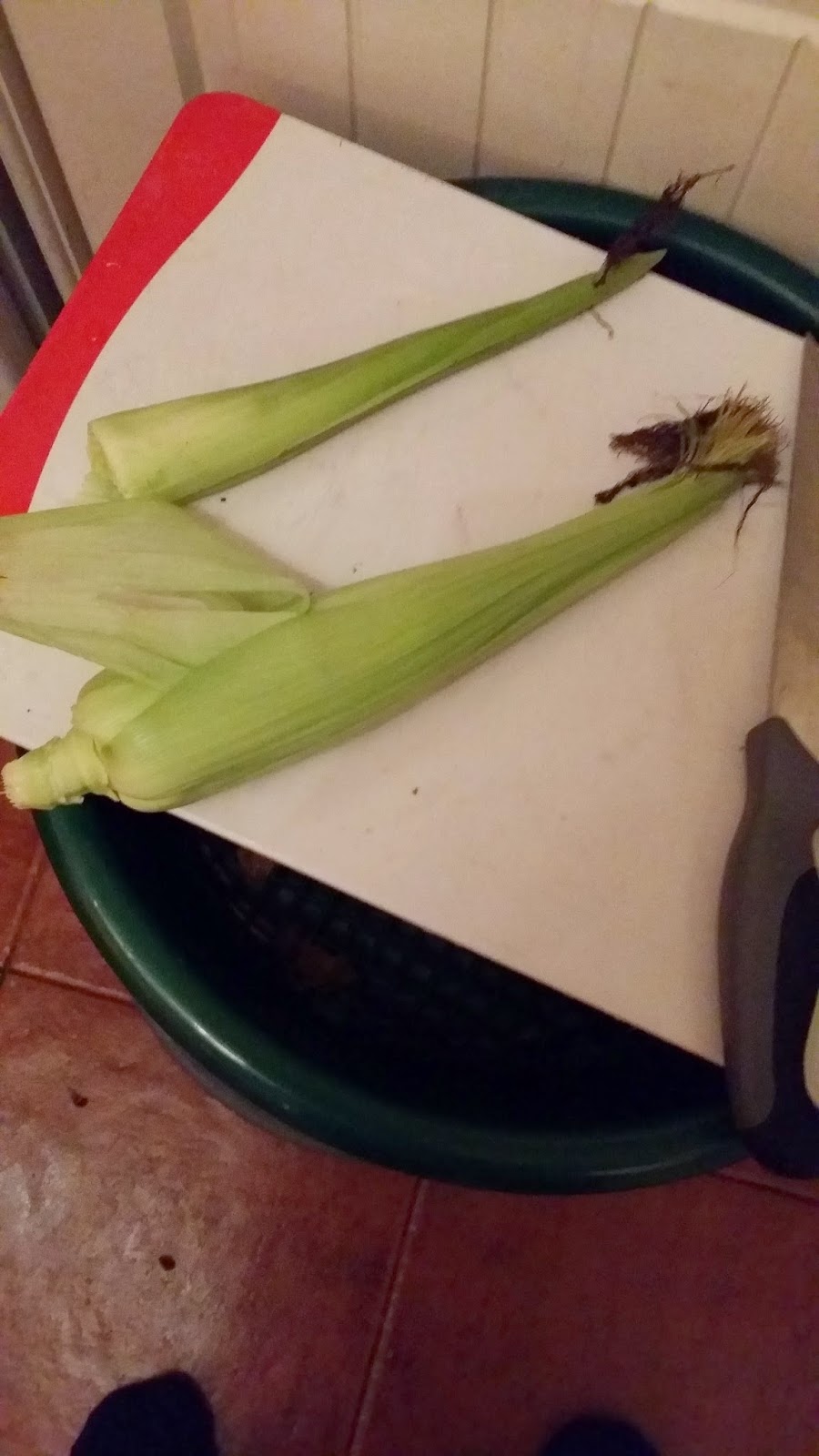
Corn is viable to eat when the top tassels turn a chocolate brown, but it's impossible to tell from the outside if you've got anything or not as the actual eaty bit is concealed inside the green bits. So I harvested a few likely looking husks and carried them into my wife, who was declared expert on the grounds that I didn't know what I was doing and she didn't say "Not it" quickly enough. Plus, she's admitted to liking shop-bought corn before - that's plenty expert enough for me and frankly she should know better by now.

The husks felt light and I wasn't a hundred percent convinced that there was actually going to be anything inside. I thought we were going to peel away layer after layer of husk like an organic pass-the-parcel before discovering that nothing had actually grown. Imagine my surprise to find that we ended up with something that looked like you see on television!

 Before...

And after - wait, did I make that? That looks like real food! My wife used to do magic; I wouldn't put it past her capabilities to sneak in some professionally-grown corn and switch it out with some legerdemain to save my feelings. Thanks sweetie!

The corn was wrapped in aluminium foil with pepper and melted butter and oven cooked for about 10 minutes to my wife's expert instructions.


The results? Interesting more than delicious. It was very sweet and the taste was a concentration of all of those times I've eaten sweetcorn in the past and thought, "This is okay actually," without any of the bitter disappointment, aftertaste or horrible texture that ruins that thought a milisecond later. Fresh really does make a massive difference - it removes all of the nasty bits of the taste from it.

However, with all the nasty bits gone, I was left with a taste that was just okay without ever blowing my mind. It was nice enough, and I'll eat the rest of the crop this year with pleasure, but I'm not sure if I'll grow it again next year, especially given how much of a pain in the arse it was to get viable plants going without dying or being devoured. Not to mention the money I spent on constantly rebuying seedlings. Plus, since the whole point of it is that it tastes different and nice when fresh, there's very little point in trying to store it, which leave me in the situation I am now - there's two husks ready to go, but I don't fancy it right now.

It will entirely depend on if I have a spare bed in the garden once everything else is planned out, rather than being something which I will actively make space for.

PJW