Showing posts with label storing. Show all posts

Monday, 3 November 2014

Squirrelling away for the winter

This weekend has mostly been a weekend of worrying about whether I'm going to have enough food to last the winter. The garden has gone back to the same level of production that it had in June - if I harvest enough vegetables for a full meal then it feels like I've taken half the available plants. No beans, no broccoli, no courgettes means there's almost nothing that's cut and come again and so I'm actively ripping up 4-5 plants just for one meal, which is dispiriting.

It's not helped by the fact that most of my early winter vegetables are a pathetic failure. The late broccoli is just sitting there producing nothing, the kale and spinach are doing a brilliant job feeding the local wildlife and my winter cauliflowers are going the way of all cauliflowers in my garden. Plus one of my successful crops from last year has massively let me down - I've had swedes taking up a plot in the garden since May and they're producing sod all. The green tops have died off most of them without a root being formed. I might get one, if I'm lucky.

Not pictured - actual swedes

In addition to this, I've learned a valuable lesson about leeks this year. I'd always assumed that they were above ground plants because, well, they're green and leafy at the top. However, the key words there are "at the top" - the white edible bit is underground and you want to bury as much of the leek as possible so that the white bit is longer. The idea is to dig a hole, drop the baby leek at the bottom of it and then progressively fill in the hole as the leek gets taller, blocking out the light to more and more of it and making it have a long white stalk before it gets the reward of green leafy bits in the sun.

Wrong.

I misunderstood these directions and planted the baby leek on top of the compost. By the time I'd realised my error it was far too late to do anything about it other than to make little hillocks of dirt in an attempt to blot out the light. I've never been particularly good at building sandcastles and so I've ended up with massive leek plants and only enough edible leek for a third of a meal from each plant.


I can also bring you the results of the great carrot experiment, which were... not what I'd hoped for.

Looks promising...

The most flagrant false advertising of size since my size 13 feet. There's no teaspoon for comparison in this picture, but I feel you don't really need it to get the idea.

I'm not even angry - this is just amusing now. I put in so much work into that horrible sand and compost contraption, spent a silly amount of money and my reward is a lot of greenery and three pencil-thin carrots that were actually inedible anyway because I'd left them too long and they'd started to go to seed. I suspect the compost was too rich for them - I did try and weight the fertiliser towards root-growing, but it clearly hasn't done the job.

So, what have I learned from carrots this year? They don't like growing too close together, they don't care about getting special treatment in pots, they don't like having an open bed for them, they don't like being fertilised too much or too little, you can put in a phenomenal amount of effort only for your best results to randomly come from a bed which you did as an afterthought, and any attempts to replicate the conditions that led to a good result lead to sod all the next time.

In short - fuck carrots.

Parsnips are my new best friend now. I don't even like the taste that much, but fuck carrots, seriously. I grew the parsnips on a whim because my daughter and wife like them. They were put into a random cheap pot that I happened to have spare, with whatever compost happened to be left over, and they were just left to get on with it.


I literally gave no fucks about the success or failure of the parsnips - daughter's food is exempt from the challenge (as she gets to eat stuff that's good for her regardless of whether daddy's capable or not) and wife can live without parsnips - but that appears to be the key with root vegetables as they grew quite happily on their own. I only realised that I might have a bit of a success on my hands when I moved the pot for some reason and realised that there were parsnips trying to grow out of the bottom and into the concrete.

The next shock came when I tried to harvest one, only to realise that I couldn't get it out of the pot because it and its neighbour has grown so big that they were wedged in against one another!


Given the personal space requirements that carrots have been having, it's quite refreshing to have a plant that will literally expand to fill the available space. I emptied the entire pot and got this haul:


Every single plant had grown so wide that it was rubbing shoulders with its neighbour; they literally could not have done more with the available room. Notice the one on the far left - it's reached the bottom of the pot, taken a right turn and just kept growing sideways cause physical limitations are for wimps. Did I mention how much carrots can go fuck themselves?

So, yeah, I need to learn to like the taste of parsnips as they are now my forever friends, fuck carrots, and they will be forming a bigger part of my winter diet than I'd originally planned.

On the bright side of winter food, it is now November and I still have a freezer drawer full of frozen vegetables from my success earlier in the year. I'd hoped that I would last all the way until December before having to dig into this, but at least it is there. I've planted some late broad beans and cauliflowers in the hope that they'll overwinter and be ready for the spring, so maybe I'll have some extra fresh veg in March/April. Then again, we are discussing cauliflowers in my garden, so maybe not.

Spring's December's Tomorrow's food.

I've started stashing away potatoes in the freezer too in preparation for the void between the last ones being dug in December and the first new ones being ready in May/June. I've ordered a new variety of seed potatoes this year which are supposed to be very, very quick and will be ready by May. I'll wait and see.

PJW


PS. Fuck carrots.

Tuesday, 19 August 2014

Courgette Envy - How to play along at home, part 3

Courgette Envy sounds like a weird band name.

My eldest sister last year acquired a garden of her very own and was very taken with the idea of copying my grow-your-own efforts. I recommended a brassica cage, a few plants that were rewarding to grow, and a few bits of hard-won advice that I'd worked out from two years of experimentation. One of the things I especially recommended was a courgette plant, which would also be my first recommendation to anyone looking to dip their toe into GYO.


Five reasons to grow courgettes at home:
1) They're very hard to kill and very easy to grow. If they weren't so useful, I'd swear they were a weed.
2) They produce loads of fruit*. One plant alone will do plenty for the average person's needs and two will keep you very well stocked.
3) They're perfect for container gardening - they can grow in even quite a small pot, so so excellent surface area/food ratio and brilliant if you don't have anything but a patio.
4) They are very cheap - I got my pots at Poundland and my seeds at Lidl, so all I really had to pay for was the dirt.
5) They taste completely different when grown at home to the rubbery, tasteless mushy stuff that populates supermarkets, especially if you go for a yellow-skinned variety which are far more tender and far less bitter than the green ones that you're thinking of if you're making that face. Yes, I can see you doing it. Cut it out and give them a chance.

Growing courgettes is the simplest thing you'll ever do in a garden. You can either sow the seeds inside in April in little seed trays and then repot the seedlings outside in May, or you can just sow them directly into the big pots in May. They will grow without too much attention from you and form big-leafed spiky plants with plenty of flowers. Each flower will elongate out into a stalk that will thicken into a courgette. The size of courgette possible will depend on the size of the pot that it's in and you'll learn to recognise that after the first few. When they're at optimum size, twist it off straight away and then the plant will focus on growing more. A well-fed plant will produce one a week - I feed mine every other day (or so) with Tomorite, which is £3 for about 100 doses and produce results along this sort of size:

No traditional teaspoon for size-comparison today, so that dish they're in is the size of a small plate. Just in case you were curious.

Now, my sister has grown her courgette plant in the ground, inside the brassica cage, against my recommendations. I was of the opinion that she could get another broccoli plant in there and using space in the cage was a waste for a plant that caterpillars don't eat. However, she wanted everything together and so overrode me and put it into the ground. Now, both of us are rueing our decisions, for different reasons.

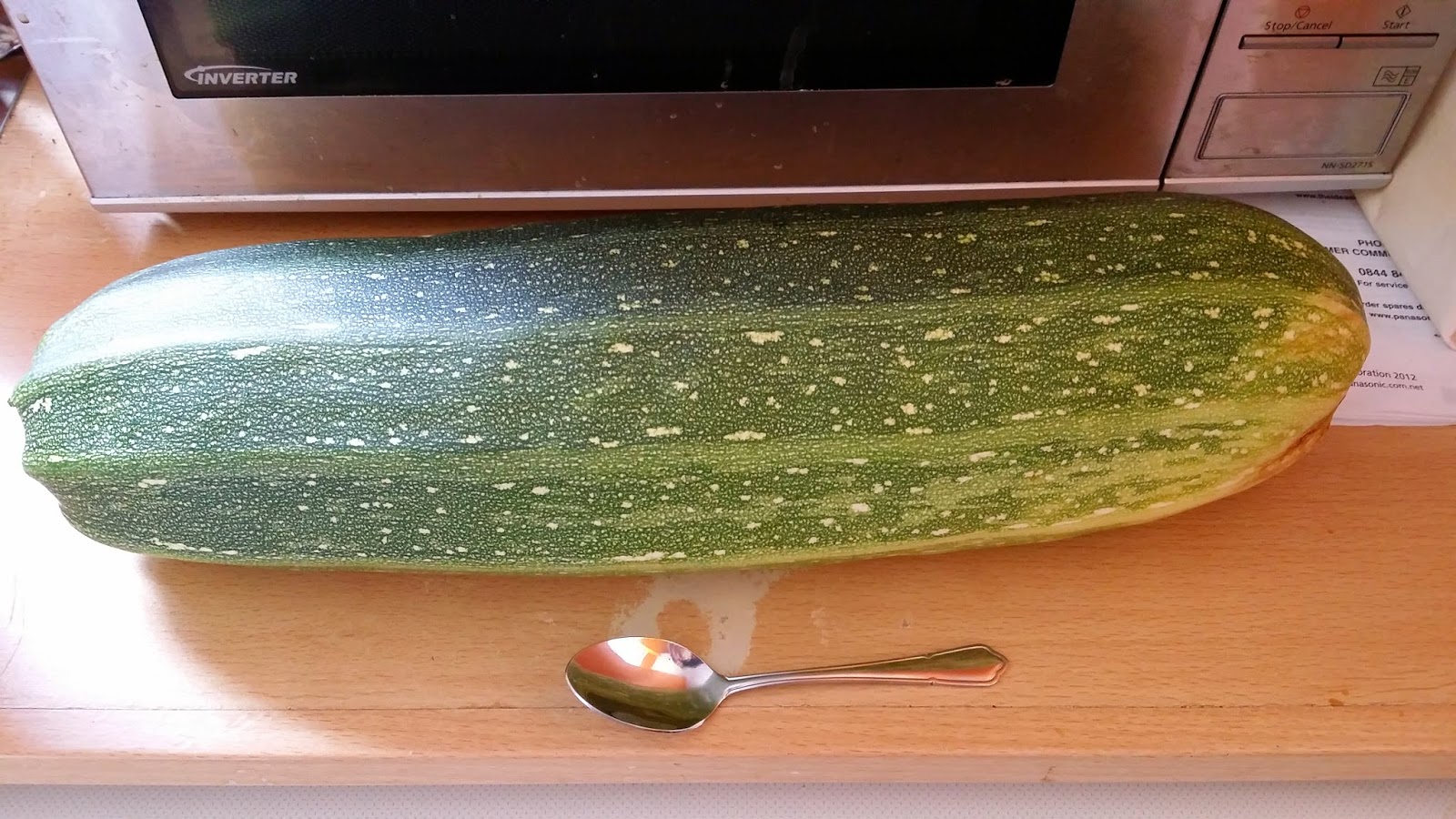
She offered to give me a courgette from her garden this weekend and I arranged to trade her one of my yellows for her green, as I thought it would keep to the spirit of the challenge. I wouldn't be importing food, but swapping it, meaning that the vegetable would still be the result of my garden. I knew my sister said they'd grown very big, so I cultivated the biggest courgette I could with extra feeds and watering, to make sure it was an even trade.

I'll spoil the ending and let you know that it wasn't really an even trade

My sister has managed to grow a marrow. It's got to be at least two foot long and for girth I can't quite reach all the way round it even if I'm using both hands. I had to put a plastic bag over the end after I cut it for its first use and it was alarmingly akin to applying a condom to the Incredible Hulk.

HULK TRUST YOU, BUT PREFER TO GET MUTUAL STD TESTS DONE BEFORE SMASHING BAREBACK!

Apparently the plant itself has taken over the bed and is bullying the brussel sprouts, who are normally the big kid in the playground. It also defends its bounty by hiding the fruit in thick leaf cover and spikes that are verging on thorns. Needless to say, next year she plans to take my advice and grow in pots, while I'm already working out which bed I can set to one side to grow my own monster.

I plan on chopping up, blanching and freezing as much of it as I can, in the same way I described last month. It won't store to be used as a standalone vegetable, but frozen courgette will go great in stews and soups. It'll be a useful addition to the winter arsenal, especially since the beans supply has now dried up without me ever getting around to really saving any of them. Slightly worried about running short come January...

PJW

*Yes, it's a fruit. The eaty bit is fleshy with seeds in the middle. Bit of wisdom for you - don't put it in a fruit salad.

Wednesday, 30 July 2014

Harvesting and storing

The broccoli has started coming in across the last fortnight and it's been abundant. The brassica cages have been an absolute, unqualified success so far; I wish I had pictures of last year's crops to show so I could compare and contrast. Shockingly enough, I wasn't particularly keen on photographing the mess that I had last year - I was more interested in trying to spot and pick out cooked caterpillars before I ate them.

My saviour!

They are by far and away the best investment I have made in my garden in my three years of doing it and I'd say they're an absolute must if you're planning on growing anything leafy like cabbages, broccoli or cauliflower, even if you only get small ones for the individual plants. An ounce of prevention is worth a pound of cure and keeping the butterflies and snails (and cats) from getting to my beloved brassicae has made my life so much easier.

So, away from the love-letter to the cages, back to the broccoli.


Of course, almost all of the broccoli has come to fruition at the same time. The florets of calabrese broccoli are basically repressed flowers and the aim of the plant is for those flowers to come to fruition. Of course, your aim is to get the head as big as possible before it turns into horrible bitter seedy flowers, which is a delicate balancing act and one made more difficult by the recent hot spell. Broccoli are cold-weather plants, so if they overheat, they think they're imminently about to die and so immediately switch to flowering mode to try and spread their seed before their demise.

Therefore, I've ended up with a mass of broccoli this week. Technically speaking, we could just eat broccoli every day until the glut is gone, but I am both lazy and very poor at managing my eating habits, so that seems unlikely to happen. Instead, I have gone down the route of freezing what I haven't eaten/cooked and stored for daughter.

For those playing along at home, broccoli and other green vegetables are the easiest things in the world to freeze. The trick is to cut it into florets and then blanch them, which is basically scalding the vegetable for 2 minutes in rapidly boiling water before dunking in very cold water. The short time in the heat destroys the enzymes that degrade stored vegetables and also kills off a load of bacteria, while the cold water stops it from cooking through. You can then drain off the water, put in a zip-bag and freeze in the bottom of your freezer. Et voila, instead of having a fortnight of nothing but broccoli and then none till next year, this broccoli will last till November and next month's secondary harvest will do me through Christmas and into the new year.

Of course, I complain about having a surfeit of broccoli now, but this is going to seem like halcyon days once the green beans come in next month.

Yes, every one of those little stringy bits is going to turn into a green bean. No, I don't think scurvy is going to be an issue this month.

PJW