Showing posts with label corn. Show all posts

Sunday, 1 May 2016

Where the hell I've been

Wow. July, huh? That's quite a long time ago, isn't it?

The thing with gardening is that it requires time, especially if you're planning on writing about it afterwards. Something else happened in July which put something of a crimp on my time:

Daughter 2 of 2. Please see instruction manual for correct operation details.

Turns out that two daughters are actually more than double the work of one and I didn't actually get back out into the garden after that last post. This meant that a lot of it died a horrible, painful and messy death.

However, there were some successes from the year. I learned a great deal about sweetcorn and the fact that you do need to give it an awful lot of space if you want to get anything from it. I produced a massive amount of plant and sod all actual food from my Three Sisters garden. In fairness, the beans and the courgettes did produce, but I didn't get a chance to get out there and harvest, so they rotted on the vine.

I also learned about some of the odd foods that I grew. New Zealand spinach/kokihi - tasty, virulent, produces like nobody's business but not something I use very often in cooking. Oca - generally tasty, requires more space than I gave it, really didn't play nicely with the tomatoes. Purslane - hard to tell apart from weeds and probably got uprooted, as I got none. Sea kale - does not like pots and takes a year to thrive even in the ground. Daylilies - delicious to slugs and snails, dead now.

I also managed to achieve my goal of a purple soup. The purple cauliflower let me down, but I managed to use ordinary white cauliflower without diluting the colour of the purple potatoes and purple carrots too much.

So, now the daughters are both a little bit older and I have a little bit of free time back. Back to the gardening? Well, yes and no. I've just moved house this month, which gets me a larger house (to fit all the daughters that I have in), but significantly smaller garden space. I reckon I can fit in 2 of raised beds in the back garden, which is something of a downgrade on the 14 that I had at the old place, not to mention the myriad planters, pots and bags that were scattered inbetween.

This has forced me to a) concentrate on what I actually want to grow and eat, and b) get creative. The front garden now contains 2 x fig trees, 2 hanging baskets of strawberries, 1 hanging basket of blackberries, 2m of window box filled with strawberries, 2 blueberry pots, 1 gooseberry in a pot, some jerusalem artichokes, 3 planters for oca, and a bed which I plan on putting 2 rhubarbs and surrounding them with nasturtiums so that they don't look weird. I've also managed to find a very interesting bush raspberry - instead of growing up tall and taking over, it spreads outwards and can form a hedge, so I've got three of those on order. Oh, and a dwarf cherry tree. Front lawns are overrated.

Of course, this downsizing does mean that I've got an awful lot of stuff that I need to get rid of. Remember the broccoli cages that I constantly effuse over? Well, I have about 7 of them and need only 2. The spares are free to a good home, or even a mildly bad one.

Also, I have about 7-8 raspberry plants going spare, as well as some seed jerusalem artichokes. I would recommend both to anyone with even a little bit of space in their garden - they grow straight up, so require very little dirt, grow anywhere without complaint and produce loads of fruit/tubers. Anyone who wants one/some, let me know.

Oh, and there's plenty of mutant raspberry if anyone wants that. It has eaten through all of the barriers and colonised the bed next to it. I think moving was worthwhile just to put some distance between me and it.

PJW

Friday, 24 July 2015

Growing a vegetable jungle

One thing which I didn't mention in my previous round-up post was the latest on the Three Sisters bed. That's because that's where most of the interesting things have happened in my absence and I felt it deserved a post (and a pic-spam) of its own.

For those who don't have a slavish devotion to my back-catalogue, the Three Sisters is based off an Iroquois tradition of growing corn, squashes and climbing beans together. The idea is that the beans fix nitrogen from the air into the soil, benefiting the corn and squash, the squash covers the ground with big leaves, preventing weeds from impacting the tall beans and corn, and the corn provides a climbing frame for the beans and a windbreak for the squash. It's a win-win-win. In theory.

Last year was a qualified success. The inter-connectedness of the three plants didn't really work out. I was worried about the English climate resulting in the beans overshadowing the corn and so chickened out by planting them up bamboo canes, which turned out to be pointless after I discovered I'd actually planted a non-climbing dwarf bean by mistake. Plus the pumpkins were an utter failure that not only failed to produce any fruit, but also broke out of the bed and attempted to throttle half the garden in a bid to survive. Said bid to escape meant it did very little shading. Still, I got both corn and beans out of the bed and the nitrogen fixing presumably worked, so, yeah, qualified success.

This year is so far a different story:

I think that is the most concentrated greenery I have ever accomplished in my limited gardening career.

I'll take you through the story so far. I started with my plan of attack, scribed in that most notable of tools, MS Paint.

Copy-pasted from the much larger garden diagram found here, cause I can't be arsed to draw it again square.

First off, I ditched the pumpkins of last year for courgettes, on the basis that a) I've had success with courgettes before and b) I actually like courgettes, which is more than can be said for squash or pumpkins. I also made the decision to go all-in and grow the beans up the corn instead of on a separate bamboo wigwam.

The bed is 1.25m x 1.25m and I started working on the basis that last year's efforts showed I could get good results from sweetcorn that was planted about 40cm apart, while my sister's garden showed that courgettes required room to spread when planted in the ground rather than a pot. So, I put the courgettes in the corners and worked out the tightest arrangement of corn/bean planting possible to squeeze in as many plants in as I could. This turned out to be 7 - two lines of three flanking the courgettes with one in the middle for luck.

Growing the beans up the corn introduced the issue of timing into the mix. The traditional Iroquois method sees all three seeds planted simultaneously, but the cooler English weather would mean that the corn would grow too slowly to support the beans and the leaves on the beans would grow so thick and so fast that they'd shade out everything else. After a small false-start with switching type of corn and a failure of the initial courgettes seedlings, I ended up doing the initial planting of the bed mid-May, with the beans not going in until a month later to give the corn and courgettes a head start.


Don't mind the oca that's appeared at the back, or the dwarf bean that's appeared at the front. Gardening plans are always flexible and I'm never immune to the urge to try and squeeze an extra plant into the space that's not really available.

From there, it's just been a case of letting it grow up and training the beans to grow up their appropriate corn stalks.


For scale, the tallest sweetcorn plants at the back are well over 6ft and still going.

However, the training effort went on the back foot pretty much from the get-go - the close-planting of the corn/bean units and the location in a corner has meant that it's become more and more difficult to get access to some of the sections of the bed as the foliage thickened. In addition, my attention to the garden suffered a bit from the impending arrival of Daughter II (The Daughtering) and the climbing beans were left to fend for themselves for the past few weeks as other things more urgently required my attention.

That has resulted in... well, neither words nor a still picture can do it justice.


Whether I'll see any beans from this bed is, as I said in the video, slightly up in the air (which is more than can be said for some of the beans' growth habits). However, I have already got significant courgette success and the corn is looking promising. With luck, the bed should provide a lot more than just "a valuable learning experience". And hey, at least it's been fun.

PJW

Friday, 29 May 2015

Overwinter vegetables and first meal of the growing year

Yesterday, I ate my first full meal from the garden, a good two weeks earlier than I did last year. I was very pleased with this. It was horrible. I learned a lot.

The meal was this:

Invisible chips!

Steak, chips, early broad beans and carrots, with the latter two coming from the garden. In theory, fairly simple.

The broad beans came from a November sowing to survive over the winter and provide first vegetables in March/April time. They did the surviving thing great, but failed to produce anything more than leaves and some very nice flowers in April, upon which point, I promptly forgot about them. April's a very busy time as just about everything wants sowing then and my wife and daughter occasionally want attention too, they were right down the bottom of the garden and they kinda... well, fell out of the back of my head.


Until yesterday, when I spotted there were beans aplenty and harvested some of the bigger ones for dinner.


Now, broad beans can be harvested at two stages - either really early, when you can eat them whole like a French or runner bean, or quite late, when you remove the seed pods and just eat the beans inside. Yesterday, I thought I was eating them early. Turns out I'd missed that point by about a week or so. Bugger.

Still, my incompetence aside, there are other beans developing on the plant, and I have now learned to pick them before they look like the above picture. The bitter horrible taste has helped me grow as a person and as a gardener. I'm not sure what my wife gained from the experience. Perhaps nausea.

Still, that was only one vegetable on the plate. Surely the second vegetable could make up for it. Not as though it's my nemesis or anything...

You may remember last year that, in the midst of the great carrot experiment disaster, I had a problem with non-sprouting seeds late on in the planting season and subsequently planted a quick-growing variety in the hope of trying to get them up before the end of the year. I failed utterly at that, but decided to keep the pots going in the hope of overwintering the carrots and getting something useful in the spring. You're not really meant to overwinter carrots, but I thought, if it's good enough for the broad beans, it's good enough for the carrots.

It worked:

Holy crap, actual carrots!

Sort of. These carrots were perfectly edible, if not particularly well sized - that little collection up there was worth just under one adult's portion and I ended up scrubbing them rather than peeling them for fear of them disappearing on me. However, planting in August and harvesting in May has ended up with some very confused carrots.

Carrots are a biannual plant, that we treat as an annual. Basically, they're designed with a two year lifecycle - they grow first year, survive the winter and then use the second year to turn into pretty flowers so that they can spread their seed. The tasty bit is where they're interrupted halfway through, when they've stored up enough food to survive winter, but before they've put any of that into being a flower.

These ones have survived the winter, started thinking about turning into flowers and then have been yanked up and eaten. As a result, they ended up being neither one thing nor the other. The outside was nice, but each one had woody cores that just had to be eaten around. Considering that they were too skinny to peel, that didn't leave much actual eatey-bit.

Tasty. I don't think my wife's forgiven me for cooking her dinner yet.

However, overwintering carrots is still a partial success story, and I think there's options to improve. People on the interwebs have tried this before me and a bit of research suggests that I want to plant them a month earlier and harvest them at least 2 months earlier, in order to give them a bit more time to prepare for winter and a bit less time in the spring to think about flowering.

Basically, overwintering beans and carrots is great and could feasibly result in me getting first meals as early as March. I've just been slightly incompetent this year.

In other garden news, I am very close to my first functioning cabbage, which will no doubt be used to further my 1 year old daughter's education in her Polish heritage with glomkis. I think that'll be ready for next weekend. We had also had our first five strawberries from the clay pot, which I made the mistake of harvesting while carrying said daughter. She took one out of my hand, decided it was nice, and then demanded the rest. Wife and I shared one between us.

The strawberry plants that were involved in the accident appear to have mostly survived, although they're still a bit too traumatised to produce fruit yet. Lots of flowers and leaves, no fruit.

And finally, as I'm sure you've all been waiting for, the results of the final two Ruby Queen sweetcorn sowings:

Guess it wasn't the plastic root-trainers that caused the last 52 seeds to fail, huh.

Nothing from another 5 seeds. Quelle surprise. Also, bollocks.

Still, I have planted out my three successful Ruby Queen plants and hopefully they are enough to be fertile with each other and not too inbred.

Cletus, the slack-jawed sweetcorn husk, in the making

PJW

Tuesday, 19 May 2015

My mind is going... I can feel it.

Always label everything in the garden. You always plant seeds and you're so enthralled by the idea of what you're planting that you're convinced it's burned into your memory. Then you go away for a week or two and do real life stuff, only to end up with this:


I have no idea what these are. They're definitely intentional, but that's pretty much all I've got. Courgettes, maybe? Asparagus peas? I don't think they're dwarf beans, but I can't rule it out. What really bugs me is that I distinctly remember being pleased about planting them, about having found a place where they'd fit, because I was worried I wouldn't have room. But nothing besides remains - it's been eaten by mortgage broking.

I don't even remember if there's actually meant to be three of them or if there's only meant to be one and I was going to weed out the weakest two seedlings.

It's made worse by the fact that this is one of a set of two identical planters in my garden, which I normally plant identical crops in. The second one also has something unidentified growing, but it's clearly not the same thing.

Don't drunk-garden, kids.

Chard? Parsnips? Beetroot? Spinach? Could be anything. Vegetable surprise.

What hasn't been a surprise is the winner of the sweetcorn race of last week. Bloody Butcher produced seedlings in 7 of the 9 pots planted and actually produced 2 seedlings for 4 of the pots. That's 18 seeds, 11 germinations, resulting in 7 successful seedlings that are now thriving in the Three Sisters bed.


The second batch of Ruby Queen, on the other hand...  has been slightly less successful.

ONE!?

One damned seedling, again growing at a ferocious rate yet surrounded by barren earth. That's 1 from 26 seeds in this sowing, bringing us to a grand success ratio of 3 from 55 seeds. Radioactivity be damned, that's a shitty strike rate. Unfortunately Ruby Queen is very difficult to get in this country, as it's not a popular cultivar (no idea why!) over here, so I can't even change supplier and blame the seed.

My only thought is that the Ruby Queen has been planted in the plastic root-trainers, while the Bloody Butcher has been solely planted in the little degradable fibre-pots. Technically speaking, the root trainers are supposed to give better performance (which was why the Ruby Queen got in there, being first-sown and the preferred crop), but I suppose it could be a factor. I've planted the last five kernels of Ruby Queen into two fibre-pots, in an attempt to get one more seedling to at least allow me to plant a block of four plants.

Soon to be 3 from 60

That picture is everything that's growing under the artificial sun at the moment and represents the tail end of the indoor planting season. On the left are my new sweetcorn disappointments, the middle is swede and the right are replacement courgettes for the one casualty of the garden so far, which was either squashed by cats or hamstrung by slugs.

This weekend, I'm sowing the beans for the Three Sisters, a couple of rounds of dwarf French beans and the winter vegetables and then that'll pretty much be it for sowings for this year's crops. Next up - the actual eating.

I hope.

PJW

Tuesday, 12 May 2015

Sweetcorn racing

One fact which I was interested to learn recently was that modern sweetcorn is entirely impractical and mostly nuclear in origin. Wacky American scientists in the 1940s put lots of different seeds and plants in the path of atomic radiation, as they believed that nuclear war was inevitable and the best thing to do was research which foods would survive the radioactive fallout and be available to the post-apocalyptic survivors. Most plants, unsurprisingly, didn't take very well to irradiation, but a random mutation in corn resulted in a multitude of new varieties that decupled the amount of sugar of ordinary corn.

Since this discovery, people have been breeding these new varieties to try and get sweeter and sweeter corns. Nowadays, you'll struggle to find a variety of sweetcorn that isn't "super-sweet" (and, incidentally, less nutritious), signifying its nuclear origins. However, like the bulldog, cross-breeding in search of a few characteristics has left us with a poor fragile cripple that can no longer reproduce on its own. Corn kernels are supposed to be fat and puffy, as they store starch that keeps the seedling going through the long and drawn out germination process. Modern super-sweet varieties have nice tasting sugar where the blah starch used to be - quick energy that doesn't store well and doesn't last long. So the kernels look like this:

The now traditional teaspoon for scale in the background

The above picture is the super-super-sweet Ruby Queen that I've been trying and mostly failing to grow this year and the above theory explains a lot - they're just running out of stored food before they've managed to germinate properly.

2 from 18 isn't a winning strike-rate

This has left me in a bit of a bind though, as I need more than two plants to run my planned Three Sisters bed and it's not possible to mix-and-match varieties. I've planted some fresh Ruby Queen kernels in the hope of getting some more, but there's a fairly good chance that I'll get the same result again. Plus, even if I do manage to get another 2-3 viable plants from this new sowing, the two that have succeeded won't bloody stop growing and any new plant may not mature in time to fertilise the first duo,

Yep, the bloody thing's outgrown the seedling root-trainer before its fellows have even broken the surface. Strikes me as somewhat rude.

When it's good, it's very, very good. When it's bad, it's indistinguishable from a bag of Swift potatoes.

So, plan B has now come into effect. Still a red sweetcorn, but this time less sweet and more savoury and with the bonus of an awesome name - Bloody Butcher. The difference in the kernels is clearly visible.

See the results that you get with the Charles Atlas home bodybuilding DVD. Now only £9.99 for all three discs! The planting that made a seedling out of Sid!

And it seems to be paying off. I sowed nine pots last week and I've already got five seedlings poking their noses above the soil.

The pots on the left are the chard plants to replace those arbitrarily decapitated by the tortured brassica cage last month and which totally aren't my fault for killing.

It's possible that they may not taste quite as good as the Ruby Queen, but if I can get at least six viable plants (enough to do the 3 sisters), then I'll count it as a win. And hey, maybe it'll taste better? I wasn't overwhelmed with the super-sweet sweetcorn that I grew last year - it was nice enough and better than any sweetcorn I've previously had, but as someone who didn't like the sweetcorn he'd previously had, that's damning with faint praise. Maybe something a touch more savoury will hit the mark?

Alternatively, the Ruby Queen has 25 new seed sowings and about two weeks in which to impress me and produce another 4-5 plants. The race is on.

Yes, there have been more boring races than pitting two varieties of sweetcorn against each other; I just can't think of any right now, cause I don't want to. Because shut up, that's why.

PJW

Friday, 24 April 2015

Packet of 9 for the weekend?

When I told my wife last year that I was thinking about growing artichokes, she was originally very pleased with me. It took 10-15 minutes of confused conversation before we realised that we were talking about two different vegetables with the same name.

Artichoke

Artichoke

They aren't related, they don't taste the same, they don't come from the same part of the world, they don't grow in the same way, they aren't even the same part of the plant! The fact that they are both named as artichoke is because the Westerner who "discovered" jerusalem artichokes for the first time had a clear problem with his tastebuds and thought it tasted like globe artichokes. No-one else has ever agreed with this man.

Since my wife is a terrible influence on me, I decided that I'd try and grow a globe artichoke as well. It's not exactly a practical vegetable, but it seemed quite fun and my wife forced me to do it. I was told that they were well nigh impossible to grow from seed and, being of a contrary mind, I decided that I was going to try and beat the odds. Ten seeds sown resulted in one viable seedling, which flourished in the late sunshine last year and built up enough size to survive the winter freezes intact, before reacting to the spring sunshine with a sudden and abrupt death.

This was rather upsetting for a couple of reasons - I was obviously expecting a first and very satisfying crop this year, and secondly, I had already underplanted my expected artichoke plant with a third, also completely unrelated, vegetable called an artichoke.

Artichoke

The globe artichoke plant is big and leafy and requires a lot of space, but it grows mostly up, leaving a lot of ground space uncovered. It's perfect to plant chinese artichokes under the shade of the leaves, as the tubers will grow in the space just above the globe artichoke's roots. However, if you've planted the chinese artichokes and then the globe artichoke ups and dies on you, then you'll just end up with the chinese artichokes taking over the entire bed and leaving no room for any future globe artichoke plantings.

Since I didn't have time to try growing another globe from seed, I decided to go to the local garden centre to buy a ready-grown young plant. My only option was this:


There are nine plants in there. Nine! A globe artichoke plant needs a bare minimum of 0.5m2 growing space and they prefer having 1m2! Who needs *nine*!?

To make this even better, they were squeezed in so tightly that the roots were all intermingled, meaning that it was impossible to remove one without seriously damaging another. I managed to separate out five plants and pot them up without too much damage and have just composted the other four. I think I would've actually just paid the same price for a pot that contained one undamaged plant as I just have for nine plants that have spent the last few weeks trying to destroy each other for precious soil-space.

Anyway, I now own five slightly damaged globe artichokes and I'm just praying that one of them will survive for long enough to be planted in my double-artichoke bed.

From the sublime to the ridiculous, I thought I'd also show you the results of my sweetcorn growing:

I'll give you a hint at what the problem is - there's sixteen seed-tray slots and only two seedlings.

This is a major problem because of the way sweetcorn works - you have to grow lots of them in close proximity to each other so that they can pollinate each other. Two is not enough. Plus I can't just go and buy seedlings from the garden centre, as these are a special variety that produces red sweetcorn and if I mix standard yellow sweetcorn in with them, then they'll cross-pollinate and I'll get something nowhere near as cool that might not taste very nice.

I'm torn between buying new seeds and giving these ones more time to germinate. If I give these more time, then I might lose my opportunity to plant new seeds in time for them to catch up (and grow big enough to be part of this year's Three Sisters) and I could end up with no sweetcorn at all, red or otherwise. On the other hand, buying more seeds is pretty much a guarantee to Murphy's law that all of them will grow and I will end up with more sweetcorn seedlings than I know what to do with.

Thoughts from the balcony? Plus anyone want to take globe artichokes off my hands?

PJW

Saturday, 21 February 2015

New Year, New Challenges

It's a new growing season and it's almost time to start planting things again!

Last year was all about 'the challenge' - whether I could grow an entire year's worth of vegetables in my back garden and go a calendar year without having to buy any. As it turns out, I couldn't. Well, I couldn't on my first attempt, certainly not with the number of mistakes I'd made or the choices of vegetables that I'd gone for.

Now, I did consider trying again. It is possible to do, but the problem is that it's not possible to do in a very interesting fashion - the answer seems to lie in planting nothing but lots of potatoes, green beans, courgettes and broccoli, and cramming the freezer full to survive winter. This strikes me as dull.

So instead, I've decided to give the challenge a miss and instead have a mixture of productive and fun. This means that carrots are still on the list, but sod growing any orange ones - I'm growing purple or nothing this year. Same with cauliflower. I have an ambition of growing the ingredients for a vibrant purple soup.

I am also growing a lot of plants that I've found in a very interesting book, James Wong's Homegrown Revolution. The theory behind it is that there are over 2,500 edible plants that can grow in the UK's climate, but most gardening books and garden centres only talk about 20-25: sprouts, swede, carrots, cauliflower, cabbages, potatoes, etc. Back in Victorian times, people grew all kinds of crazy things in their gardens; there are reports of people successfully growing pineapples using only glass and horse manure for heating. However, this all stopped with the World Wars and the emphasis on Dig For Victory - everyone was encouraged to Grow Your Own, but most people didn't know how. So the propaganda departments made leaflets and other literature telling people how and what to grow.


So the reason why garden centres sell you cauliflowers, despite them being an absolute bitch to grow, is because a wartime bureaucrat had to make a list of patriotic vegetables - brassica made it in, while things like jerusalem artichokes and courgettes did not. After the war and rationing, people were in the habit of growing and eating the same old staid vegetables that the government told them it was patriotic to grow.

Homegrown Revolution's is a book about the many and varying vegetables that are fun, productive, make the best use of space and thrive in the UK climate. This year I will be trying out asparagus peas, kokihi, chop suey greens, electric daisies, saffron, purslane, sea kale, day lilies, dahlia yams, chinese artichokes and oca. Looking forward to new experiences from those!

January and February in the garden have mostly been about planning where I'm going to fit all of these things in. In previous years, there's been so much expansion of beds and creating new spaces, that most of the growing areas were filled with new compost and so rotation wasn't strictly necessary. This year, however, I'm absolutely determined I'm not going to create any more beds, so I've gone for some crop rotation and am resting my two oldest brassica beds to give them a chance to recover.

This means that I have two 1.25m square beds to use on interesting things. One of them is going to be set aside for root vegetables, which is a bit boring, but the second is going to be used for another go at The Three Sisters companion planting system. Last year, this experiment was notable for me planting the wrong type of beans (dwarf rather than climbing) and getting absolutely sod all out of planting a pumpkin. However, I did get some nice beans and sweetcorn out of it, and the idea of a three-way companion plant interests me enough to give it another go, but substituting courgettes in for the recalcitrant pumpkins. Plus, I found a variety of red sweetcorn to plant, which is worth the entrance fee on its own.

Do you see how cool this is!?

Here's the plan of how everything will fit together:

Click to embiggen.

This plan is already out of date and I've yet to actually plant anything out yet. Par for the course. Planting proper starts this week, beginning with early broccoli, indoor carrots, early onions and the first potato planting of the year. Looking forward to it.

PJW

Saturday, 6 December 2014

And so, it ends

Not with a bang, but with an "Oh, for fuck's sake." This was what I harvested today:


In my garden at present, ready to eat, there is one potential swede, the bags of potential Christmas potatoes and the jerusalem artichokes. That's it. And the freezer drawer from the autumn is looking empty already. I think we can officially say that I would not survive winter on my own and while it would theoretically be possible to go the year round without buying any vegetables, that would mostly be through takeaways and pizza.

Today, I go to the grocer's. Sad times.

Still, while the challenge is ended (and I don't think I'll ever try it again in quite so stern a format as I did this year), it has been fun and a hell of a learning experience. It's a long way from over yet - there's still brussel sprouts (hopefully) and purple broccoli, with cauliflower, broad beans, carrots and sea kale overwintering to hopefully come up in the spring. However, I thought that here (at the end of all things), might be a good time to reflect on things that I've learned:

1) Brassica cages and other forms of netting are brilliant. Everything wants to eat your edible garden if it can and even lethal amounts of pesticides don't really do the job. It's a hell of a lot easier to just seal off anything leafy from the evil things that want to destroy it.

As a corollary to this, I think that kale, spinach and chard may become indoor plants next year. I had great success with bringing lettuce inside and keeping it on a windowsill last year, with the only problem being that I don't actually like lettuce that much. I like kale, spinach and chard, but unfortunately so does the local wildlife, so I don't see much of it.

2) Some things aren't worth the bother. The white cauliflowers that I grew squatted in my garden, taking up masses of space and produced the square root of fuck all. The carrots also achieved little to nothing for lots of effort. Don't get me wrong - I like eating both cauliflowers and carrots, but I can go to the grocers with a fiver and come out with three large cauliflowers, a massive bag of carrots and change.

Next year, I'm cutting back on growing things that I can easily get the same quality easier and cheaper from the grocers. Purple carrots and orange cauliflowers are going to be the order of the day, along with asparagus peas, kokihi, purslane, sea kale, day lilies, dahlia yams, chinese artichokes and oca.

3) Other things are definitely worth the bother. Fresh potatoes, while still being a pain in the arse, do taste better. Sweetcorn, courgettes and mange tout as well. Broccoli and green beans aren't massively different in taste to those from the shops, but they produce masses of edible goodness in a relatively small space and the cut-and-come-again means that you get loads of meals out of them. Parsnips will also get a pass for being awesome.

4) Sometimes it's worthwhile buying seedlings rather than growing from seed. This entry shows the difference between a commercially-grown cauliflower seedling and my windowsill effort. It's very satisfying to grow something just from seed (the fact that I not have a fully-fledged globe artichoke plant speaks to that), but on other occasions it's not worth grinding your own flour.

Secondary to that is making use of grafted plants. My aubergines that I grew from seed achieved sod all, while the grafted one kept going way into winter and had to be actively put down to save the soil for next year. Little bit more expensive than growing your own, but a heck of a lot less frustrating.

5) Raspberries kick the shit out of strawberries. They've not come up on the blog much, but I bought 12 raspberry canes earlier this year and they've been producing solidly from August right the way through to December. Meanwhile, my strawberry bed emitted a brief flurry of strawberries in May and June and then settled down to producing leaves and nothing else (despite the bed allegedly containing several different varieties that should've done the whole season). Plus, there's very few pests willing to climb to get a raspberry off a cane. I think the strawberry bed might have one more year to try and redeem itself and then it might get repurposed the year after that.

What I did have success with was strawberry hanging baskets by the door. They also only produced a brief flurry, but they had the advantage of being a) away from pests and b) right there when I walked out the door. An experiment to be repeated.

I also managed to get at least 4 edible pears and 5 figs off my trees, although I expect more next year as they mature and come into their own. The dessert grapes were a massive, massive disappointment - lots of production, but what we ate made us horribly ill. There's several theories for this: I possibly accidentally picked from the wrong vine and picked unripe red grapes instead of green ones, the grapes themselves were small so perhaps not ready, we maybe didn't wash them as well as we could, the grape vines may possibly just be evil and looking to destroy us - there's lots of possibilities.

Unsurprisingly, we waited until the grapes were 100% definitely ripe, possibly even overripe, before picking the next set. Then we let them rot in the fruit bowl as my wife and I engaged in a grape-based Cold War of seeing who'd break first and eat the grapes "that were probably totally fine, really!"

Next year, there may be some kind of grape jam or amateur wine so that the evil can be processed out before we consume them.

5) Fuck carrots. Also leeks grow underground, courgettes grow huge when not in pots, pumpkins are a danger to everything while producing nothing, and parnsips can (and should) be grown in whatever leftover pot and space is available. Also, I should not be allowed to build things.

6) Winter vegetables need their own, dedicated bed with a brassica cage. Having watched my winter kale and spinach die horribly out in the open (partly through pests, partly through next door's cats pooping on them), I've decided that they need to be undercover. Also, everything needs to start earlier if I'm expecting to get crops through the year, which rules out any more misguided sharing with other main crops. I may plant quick-growing catch-crops, like mange-tout, rapini, ball carrots and chop-suey greens, for the spring, but nothing which I wouldn't be happy tearing up if the winter veg needed to go in before they were ready to go out.

Overall, I'm pretty pleased with the growing year so far. I went from June to December without buying any vegetables (a month longer than last year) and I got to eat many more things than I did last year. The count of things which I successfully ate from my garden this year is: broccoli, cabbage, cauliflower, courgette, mange tout, broad beans, green beans, french beans, sweetcorn, spinach, kale, nasturtiums, carrots (for certain values), parsnips, leeks, lettuce, aubergines, green peppers, red peppers, potatoes, onions, garlic, tomatoes, rhubarb, blueberries, raspberries, strawberries, figs and pears. Plus there is still rapini, brussel sprouts, swede and jerusalem artichoke to go.

The most important this was that I learned a lot and, as we all know, knowledge is half the battle. The other half is brutally murdering slugs.

PJW

PS. Fuck carrots.

Sunday, 31 August 2014

The purpliest potatoes and other adventures

One of the major aims of this home growing malarky is to achieve things that I couldn't get in the supermarket or grocer. And what better example is there of that than PURPLE GODDAMN POTATOES?!


It's possible that I'm more excited about this than is rational, but I think these are awesome. They're a variety called Salad Blue, which were bred in about 1900 as a Victorian novelty. Despite the name, they're not a salad potato in the slightest: they're a maincrop rather than an early, all but the smallest have to be peeled to be edible, and they fall apart if they're cubed and boiled. And they're not blue. Apart from that, great naming work Victorian gardeners!

Leaving aside the excitement of "Holy crap, purple!", the allure of purple potatoes is that they are in theory healthier. The purple colour comes from anthocyanins which research shows to have an unproven correlation with improved health and neural development (or as the Mail no doubt put it, "NEW RESEARCH SAYS POTATOES CURE CANCER"). However in terms of the taste, I wasn't blown away. They were very bland, which is weird considering you expect brighter coloured things to taste stronger.

I'm torn as to whether I'll be planting them again next year. On the one hand, purple, which is very important. They also appear to've been very prolific croppers - I've not even harvested a full potato bag yet and I've got three and a half meals out of them. And perhaps the taste issue was just this one bag and they'll improve. We'll see.


The plate of purplish chips (not as impressive once cooked. The mash that I made the next day was a bit more grey than purple too. Maybe I'll just boil them next time. Or add some food colouring) aside, there's two more interesting things about that plate. Three if you count the sous-vide perfect steaks.

The first is the end of the beans-rush. The torrent stopped as abruptly as it began; all of a sudden there were just no more beans, like someone turned off a tap. The plants are still green and still trying to grow outwards, but it looks like they're pretty much done with providing me food, bar a couple of stragglers. It's a bit of a shame actually - I spent so much effort making sure that we would eat all of the beans that I think we actually succeeded in eating all of the beans. Practically none have been frozen for the winter, so I hope we don't find a recipe that urgently requires them!

Secondly is a brand new adventure for this year's growing - corn! This came from my Three Sisters experiment, which has so far held up its end of the bargain on two out of the three vegetables. I'm not usually a lover, or even a liker, of sweetcorn, but I was told that freshly picked is a completely different flavour to canned supermarket toot and it was interesting so I thought I'd give it a go.

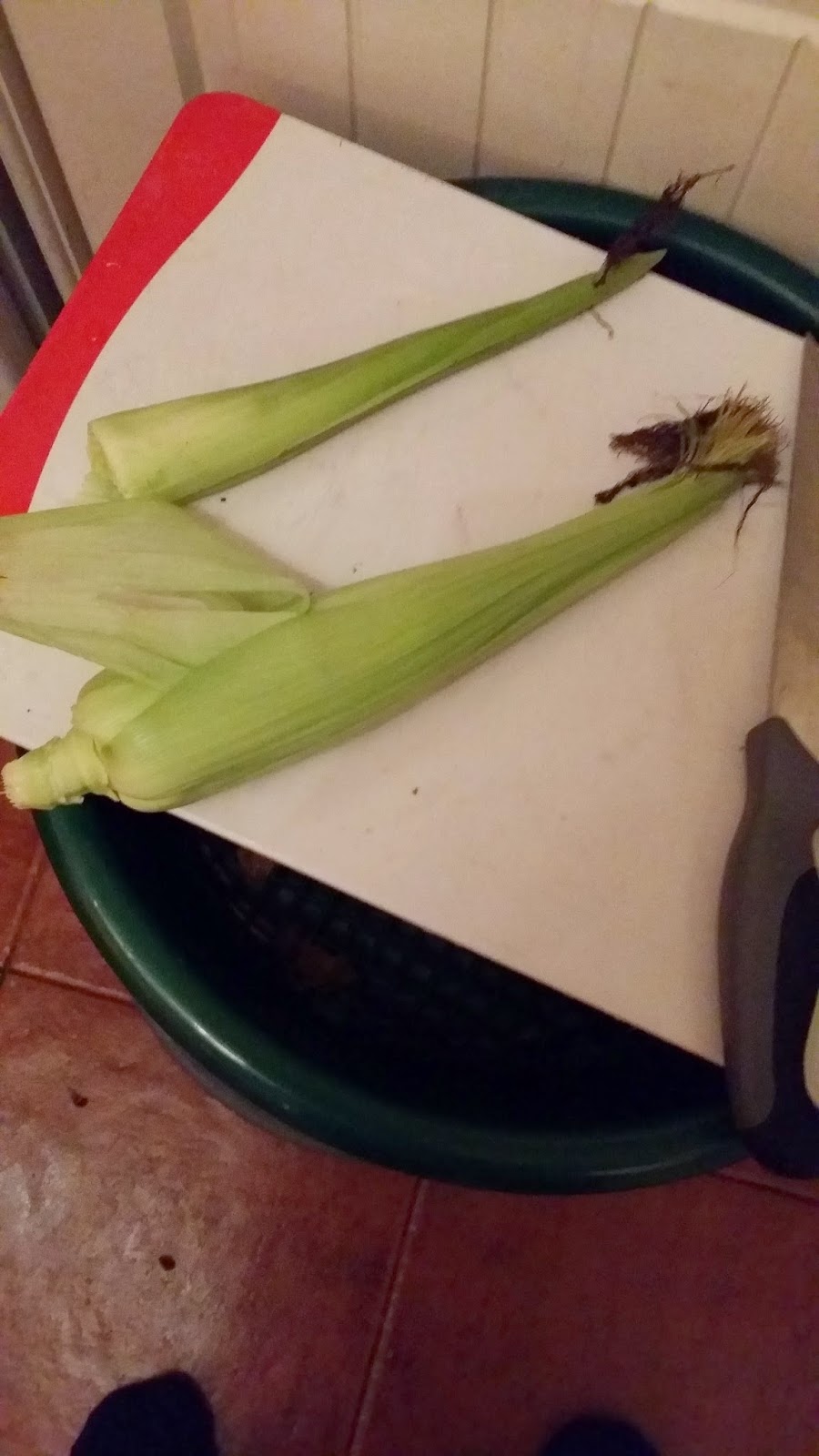
Corn is viable to eat when the top tassels turn a chocolate brown, but it's impossible to tell from the outside if you've got anything or not as the actual eaty bit is concealed inside the green bits. So I harvested a few likely looking husks and carried them into my wife, who was declared expert on the grounds that I didn't know what I was doing and she didn't say "Not it" quickly enough. Plus, she's admitted to liking shop-bought corn before - that's plenty expert enough for me and frankly she should know better by now.

The husks felt light and I wasn't a hundred percent convinced that there was actually going to be anything inside. I thought we were going to peel away layer after layer of husk like an organic pass-the-parcel before discovering that nothing had actually grown. Imagine my surprise to find that we ended up with something that looked like you see on television!

 Before...

And after - wait, did I make that? That looks like real food! My wife used to do magic; I wouldn't put it past her capabilities to sneak in some professionally-grown corn and switch it out with some legerdemain to save my feelings. Thanks sweetie!

The corn was wrapped in aluminium foil with pepper and melted butter and oven cooked for about 10 minutes to my wife's expert instructions.


The results? Interesting more than delicious. It was very sweet and the taste was a concentration of all of those times I've eaten sweetcorn in the past and thought, "This is okay actually," without any of the bitter disappointment, aftertaste or horrible texture that ruins that thought a milisecond later. Fresh really does make a massive difference - it removes all of the nasty bits of the taste from it.

However, with all the nasty bits gone, I was left with a taste that was just okay without ever blowing my mind. It was nice enough, and I'll eat the rest of the crop this year with pleasure, but I'm not sure if I'll grow it again next year, especially given how much of a pain in the arse it was to get viable plants going without dying or being devoured. Not to mention the money I spent on constantly rebuying seedlings. Plus, since the whole point of it is that it tastes different and nice when fresh, there's very little point in trying to store it, which leave me in the situation I am now - there's two husks ready to go, but I don't fancy it right now.

It will entirely depend on if I have a spare bed in the garden once everything else is planned out, rather than being something which I will actively make space for.

PJW

Monday, 28 July 2014

The Three (English) Sisters

While my garden is neither self-sufficient nor organic (and I hate the automatic assumption that organic is best and anything carrying that label is naturally healthier), I am very interested in the natural ways of getting the most out of the land and the space that you have. I've already experimented with companion plants to ward off pests, with using green manure to prepare beds and will be paying a lot more attention to crop rotation this year.

One interesting idea which I came across was that of The Three Sisters growing system, which is an Iroquois tradition of growing beans, maize and squash together. Most companion planting involves a main crop and a secondary crop in the same bed, with the idea that the secondary crop does something beneficial for the main crop without getting anything back (or in some cases, with the secondary crop being completely ruined). The Three Sisters is novel in that all three of the crops are the main crop and each of them benefit the others. The maize provides a support for the green beans to grow up, the green beans put nitrogen into the soil and the squash has large leaves that shade the ground, keeping the roots cool and blotting out weeds. None of the plants compete with each other as they require different minerals from the soil and the result is a better crop for all three.

I wanted to try this myself, but there were a few factors that were holding me back.
  1) South-west England is not north-eastern America. Maize doesn't particularly like south-west England and, if I was to plant all three plants together, the greater rainfall and lesser sunshine would result in the beans growing far faster than the maize, meaning they had nothing to grow up. Even if the maize did grow quickly enough, our climate makes for very leafy beans which would blot out the sunlight from anything they climbed up.
  2) It requires a lot of space to do properly. Every guide I've seen suggests a minimum of a 3m² space minimum - I had 1m² maximum.
  3) I don't like squash.

Minor details aside, I decided to try this out for myself. The plan was to grow green beans (up bamboo canes) in an arc at the back corner of the bed so they wouldn't shade out the other crops. The sides of the bed would be lined with blocks of pre-grown sweetcorn seedlings, while at the front corner, I would grow a pumpkin on a mound of compost. Granted, this loses a lot of the effect of the Three Sisters - the seeds won't all be sown in the same mound and the beans won't be growing up the corn, but it's still three disparate crops growing in the same bed and improving each other.


Things got off to a rocky start - I bought a set of twelve sweetcorn seedlings from the garden centre and planted eight of them in the bed. All eight I planted died within a fortnight, eaten by slugs and other predators. Thankfully, I'd kept the last four from the set and potted them up, just in case, so I was able to plant those and watch them die within a couple of days. Cursing, I bought another set of twelve... only for those to suffer exactly the same fate. At the same time, the green beans that I'd planted had sprouted, grown big and strong and put out thick leaves in order to be stripped back to the stalk by whatever was eating the rest of my garden.


Thankfully the third set of sweetcorn and the second planting of beans survived long enough for the copious amounts of slug pellets that I'd been carpeting the garden with to put a big enough dent in the local parasite population. Which led to this situation at the start of this month:


Which has now developed into this:


I am actually in danger of getting corn out of this, which is very cool. Partly because it's a new and exciting first foray into grains, which is cool, but also because I'm not the biggest fan of sweetcorn and I'm reliably informed that it tastes worse the longer its been picked. So corn that's in the supermarket tastes very different to corn that's just been from its soil untimely ripped, which vindicates my decision to grow my own rather than buy it.

Hopefully I'll like fresh corn, else this will be a bit of a failed experiment regardless of the yield. I'm already putting effort into growing pumpkins that I already know I don't like the taste of. My wife wishes to have one to carve for Hallowe'en and I'm helpless before a mild whim of the lady. Plus I didn't realise until it was far too late that courgettes would've filled exactly the same companion niche and so I could've grown something I actually liked instead. Oh well.

PJW